



MAY
27
MAY
27
The SGP.32 reality check: live demo
May 27, 2026
4:00 AM
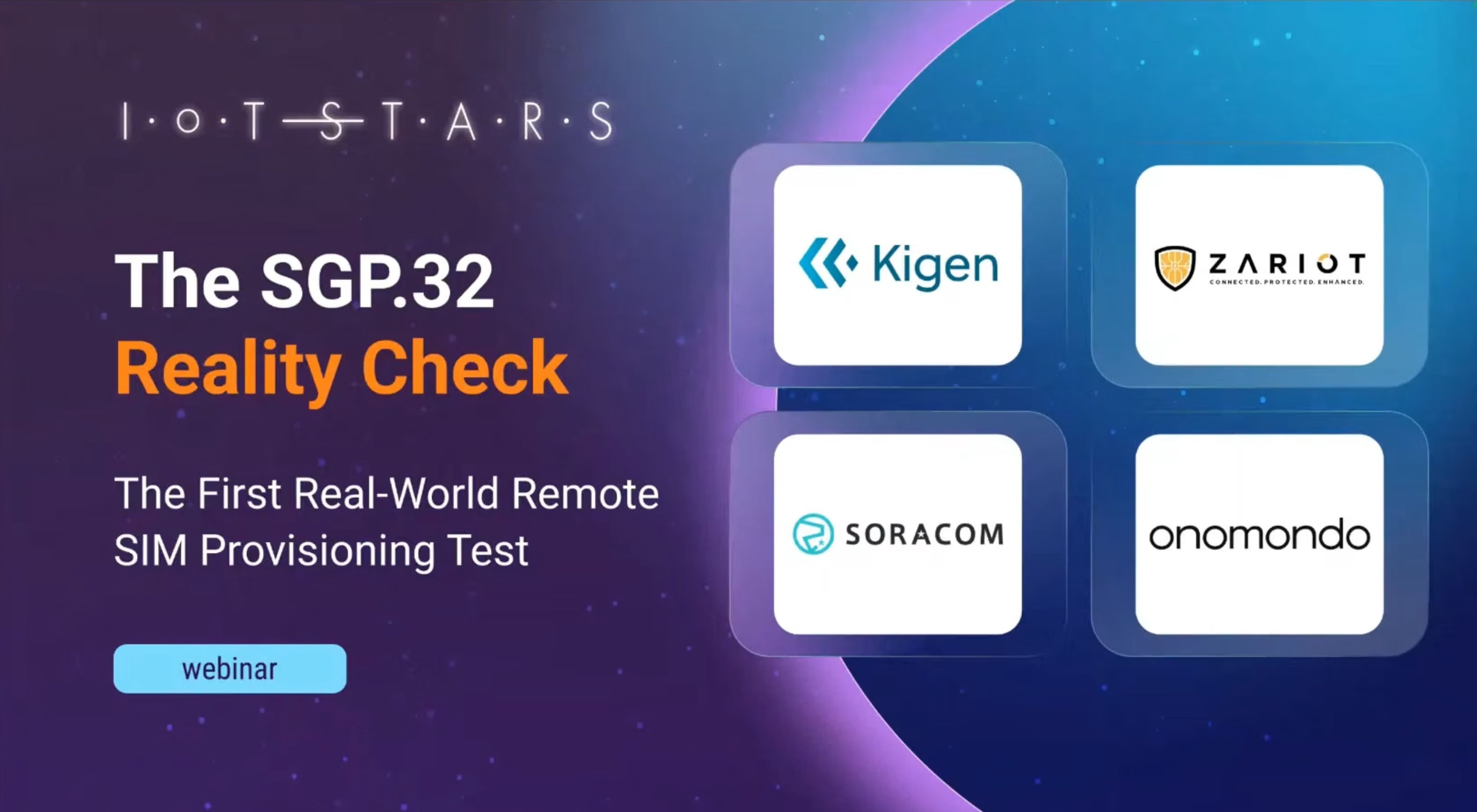
For over two years now, the cellular market has been overly excited about the remote eSIM provisioning standard called SGP.32. Connectivity providers are still dominating headlines, promising that this new standard will revolutionize the IoT landscape like never before.
The message is consistent: a new era of flexibility where the power to choose (and switch) providers is finally in the hands of the customer. On paper, every new IoT application hitting the market today should be built on this standard.
But are they? The initial specifications were released in May 2023 by the GSMA, and the final version has been stable since June 2024. That’s plenty of time to see SGP.32-ready devices flooding the market, but where are these devices? Why don’t we see them everywhere yet? Is something still holding the industry back?
Let’s unravel the SGP.32 story and find out if the standard is truly production-ready.
SGP.32 Explained
To understand the obsession, we have to look at how we got here. Consumer eSIMs are already a reality; the latest US iPhones don’t even have a physical SIM slot. For a human, scanning a QR code to download a profile is a quick and seamless process.
But IoT devices are different. They are often resource-constrained, “headless” (no screen or camera), come in high volumes, and need to be managed via the cloud. The consumer standard (SGP.22) simply didn’t fit these requirements. This led to the birth of SGP.32, featuring an architecture redesigned around three core elements:
- The Device: Running the IPA (IoT Profile Assistant).
- The Orchestrator: The eIM (eSIM IoT Remote Manager), a cloud component which directly communicates with the IPAs.
- The SIM database: The SM-DP+ (Subscription Manager Data Preparation Plus), the server where the actual SIM profiles live.
In essence, the IPA on the device “checks in” with the eIM at configurable intervals to see if there are any pending instructions, like download, activate, delete or disable a SIM profile. If a download is pending, the device pulls the new profile from the SM-DP+ and, once enabled, switches connectivity without any physical intervention. Simple, right? But does it actually work in a messy, multi-vendor environment?
Putting SGP.32 to the Test
Beyond the PR and the slide decks, IoT Stars wanted to validate if SGP.32 was ready for the rigors of production. They teamed up with Kigen and several connectivity partners who claim to be SGP.32-ready: Zariot, Soracom, and Onomondo.
Five different plastic SIMs with eUICC profiles were used, each containing an IPA connected to Kigen’s eIM. The SIMs were attached to five different host devices:
- Nordic Semiconductors’ nRF9151DK
- DPTechnic’s Walter with Sequans Monarch 2
- SG Wireless’ F1 Kit with the F1 Smart Module
- Murata Type 1SC EVK2
- Actinius Icarus with the nRF9160
The test was conducted to validate whether the SIMs would migrate between three different connectivity providers in real-time.
The Verdict: The Standard Works.
The results? The SGP.32 standard is ready to be implemented by the industry. The tests demonstrate that the ecosystem has successfully moved past the “lab experiment” phase, as devices could migrate between vendors seamlessly. As the SGP.32 standard proved to work in a real-world setting, enterprises can start embedding the remote SIM provisioning standard into their next-generation applications.
Missed the live demo?
This webinar moves beyond theory and demonstrates SGP.32 in a real-world setting. During the session, multiple IoT devices were downloaded and activated with a new SIM profile, showcasing the state of remote SIM provisioning.
We didn’t just show the technology; we discussed the real-world implications, including the impact on power management and battery life. See it for yourself and decide if you’re ready to make the switch.
Speakers

Loic Bonvarlet
Loic Bonvarlet is SVP Ecosystem & Marketing at Kigen, where he leads partnerships, product marketing, and ecosystem strategy focused on eSIM/iSIM adoption for IoT. He works across Kigen’s embedded SIM solutions, remote provisioning services, and industry partnerships

Laurens Slats
Laurens Slats is an IoT community builder and developer relations professional focused on cellular IoT and LPWAN technologies. He is a Partner at IoT Stars, a global IoT networking community that connects professionals across the IoT, embedded, and Edge AI ecosystem
Hosts

Kigen
We're making the future of securing connectivity simple. Together with our partners and customers, we are unlocking new opportunities as eSIM becomes the cornerstone of connected device security. Our industry-leading SIM OS products enable over 2 billion SIMs. Our remote SIM provisioning and eSIM services place us amongst the top 5 SIM vendors globally.

New Podcast Episode

Building Real-Time Voice AI Experiences

Related News
Shelly Launches Presence Gen4 in North America: Intelligent Occupancy Detection for Home Automation
Oct 15, 2026

Monogoto Named Gold Winner for Software-Defined Networking in 2026 Merit Awards for Technology
Oct 13, 2026

Iveda and GlobalMed to Host Live IvedaAir Flight Demonstration for Government and Defense Stakeholders
Oct 13, 2026


Related Solutions

Service Intelligence for Auto Service Providers
Gain insights into bay utilization, crew performance, and improve customer satisfaction
Gain insights into bay utilization, crew performance, and improve customer satisfaction
Leverege
Leverege


Lot Management for Dealerships
Helping dealers with quicker theft recovery, more efficient reporting, and enhanced customer experience
Helping dealers with quicker theft recovery, more efficient reporting, and enhanced customer experience
Leverege
Leverege

Yard Management for Auto Manufacturers
Enabling workers to Instantly locate vehicles, reduce labor costs and better detection of bottlenecks to improve efficiency
Enabling workers to Instantly locate vehicles, reduce labor costs and better detection of bottlenecks to improve efficiency
Leverege
Leverege

Energy Monitoring for Grocery Stores
Helping retailers reduce and audit energy consumption while eliminating equipment downtime and lost inventory
Helping retailers reduce and audit energy consumption while eliminating equipment downtime and lost inventory
Leverege
Leverege

Inventory Visibility for Retailers
Equipping retailers with highly accurate inventory cycle counting to help increase sales and reduce theft
Equipping retailers with highly accurate inventory cycle counting to help increase sales and reduce theft
Leverege
Leverege

Related Solutions
Automotive
Service Intelligence for Auto Service Providers
Gain insights into bay utilization, crew performance, and improve customer satisfaction
Leverege
Automotive
Lot Management for Dealerships
Helping dealers with quicker theft recovery, more efficient reporting, and enhanced customer experience
Leverege
Automotive
Yard Management for Auto Manufacturers
Enabling workers to Instantly locate vehicles, reduce labor costs and better detection of bottlenecks to improve efficiency
Leverege
Retail
Energy Monitoring for Grocery Stores
Helping retailers reduce and audit energy consumption while eliminating equipment downtime and lost inventory
Leverege
Retail
Inventory Visibility for Retailers
Equipping retailers with highly accurate inventory cycle counting to help increase sales and reduce theft
Leverege