What Embedded Software Must Solve for Physical AI Systems
What Embedded Software Must Solve for Physical AI Systems

- Last Updated: September 8, 2026
Lemberg Solutions
- Last Updated: September 8, 2026
As AI moves from cloud applications into physical systems like vehicles, industrial equipment, and medical devices, embedded software must transform to include AI-driven behavior control. This transformation requires combining technologies with fundamentally different characteristics: deterministic control and probabilistic AI. And the key challenge shifts from “how to run AI” to “how to make AI work reliably in the physical world.”
Thus, engineering teams and product owners need to rethink their approach to all stages of project development, from hardware selection to system verification. This article explains how AI models and embedded software interact, which aspects are critical to consider, and what you need to build a successful physical AI product.
Why Physical AI Changes the Rules of Embedded Software
Embedded software for physical AI is responsible for both AI reasoning and for safely translating AI behavior into physical action. As an embedded software development company with expertise in Physical AI, here we explain what kind of guardrails the presence of the probabilistic component requires to keep a product safe and reliable.
Deterministic Control vs. Probabilistic AI Decisions
Traditional embedded systems have predictable, algorithmically defined behavior. Given a known input, the software follows deterministic rules and produces an expected output within a specified time. Meanwhile, such features as computer vision or anomaly detection are probabilistic and decision-based: the same input may not always produce an equally certain result. This distinction is critical, as the AI model cannot define the level of predictability required for an industrial machine, a vehicle, or a medical device to operate safely. These rules should be enforced by the embedded software.
The task of embedded engineers working with such systems is to take this distinction into account and establish a proper relationship between the deterministic and the probabilistic. This way, AI will be limited to providing perception, prediction, or recommendations, while the embedded software should manage final decisions, timing, state transitions, actuator control, and fallback behavior.
Defining Safety-Critical Boundaries in Physical AI Systems
Strong safety boundaries are what keeps physical AI reliable, even when models make mistakes. Thus, the development of such applications should start with deciding where AI is allowed to influence physical behavior and where deterministic safeguards must take over. For example, in an autonomous robot, an AI model identifies an object and makes a decision to move around it. But embedded software must enforce and prioritize limits on speed, torque, position, collision detection, and emergency shutdown, regardless of what the AI model predicts.
Such a setup requires a special approach to system design and testing:
- AI proposes, embedded software decides: The AI model suggests an action, but a separate, deterministic safety algorithm approves or blocks it. So if a hardware-level proximity sensor detects an obstacle, it will override an AI vision path planner and trigger immediate emergency braking.
- Isolation of controls: Safety policies should live outside the AI model's reach so the AI cannot rewrite its own rules. Developers typically isolate non-deterministic perception tasks on high-throughput processors (GPUs/NPUs) while reserving real-time control logic for dedicated, deterministic microcontrollers running a real-time operating system (RTOS).
- Safety validation: To manage real-world risks, development teams test perception and decision stacks in virtual environments before letting robots run in the open world. Using continuous runtime monitoring, they track AI confidence scores and environmental data in real time to detect failures before an accident happens.
- As a result, AI makes the system smarter, while deterministic embedded software keeps that intelligence bounded, predictable, and safe.
Running AI on Constrained Embedded Hardware
In on-device inference embedded systems, AI models run on constrained hardware, with the compute, memory, power, and thermal resources incomparably lower than those available in a cloud or high-end edge computer. Edge AI development teams work on ensuring the AI workload fits the physical device's capabilities.
Choosing the Right Compute Platform for AI Workloads
To select the right compute platform, it’s important to understand which hardware component will be able to handle the required workload:
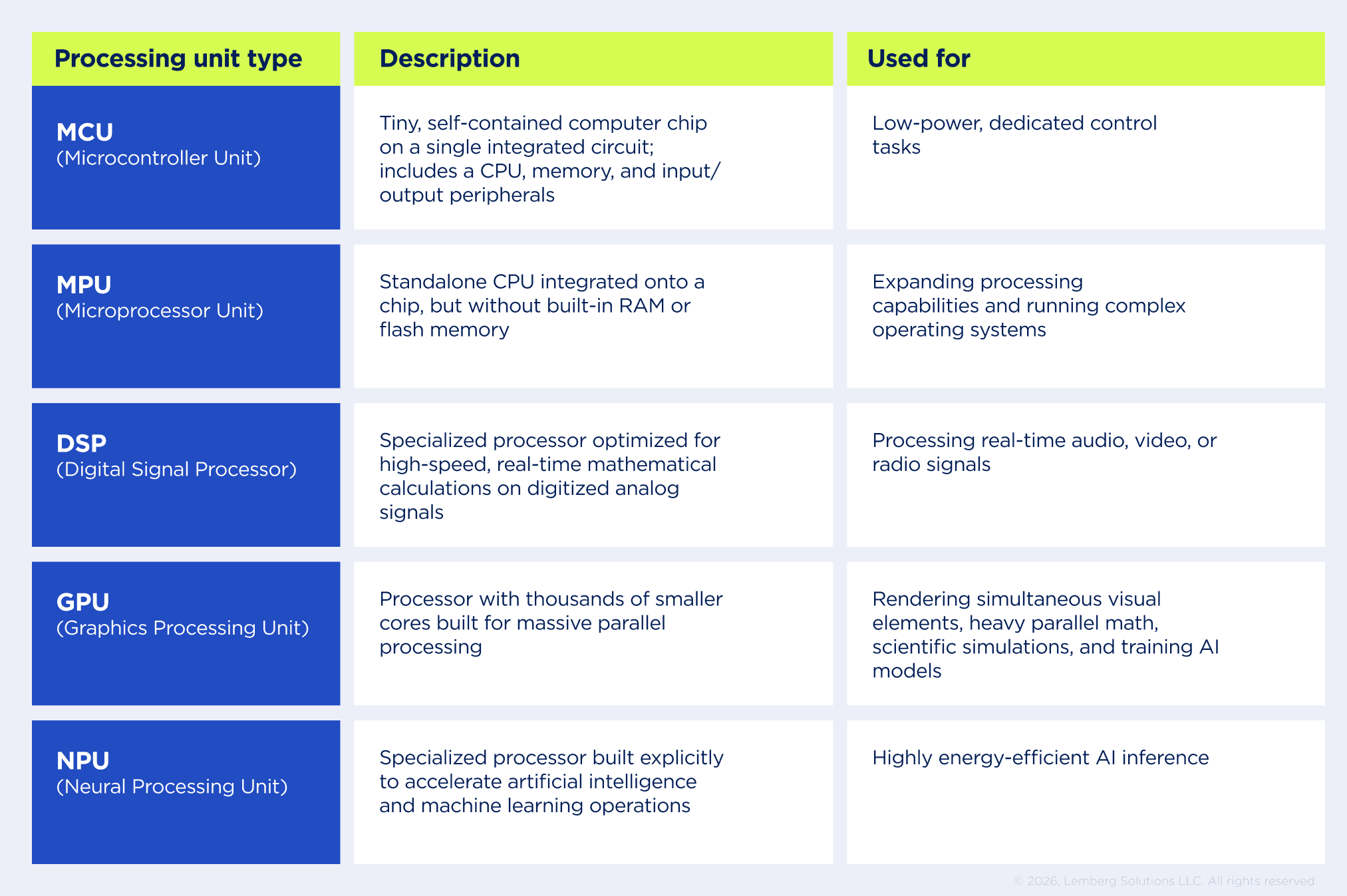
Although this list looks quite straightforward, business decision-makers must consider additional factors when choosing hardware. For example, a processor with high inference performance will affect your BOM cost, power consumption, software complexity, availability, lifecycle support, and product scalability. Since the AI model rarely represents the entire computational workload, you should evaluate the complete AI pipeline, including preprocessing, inference, postprocessing, and communication, to decide which hardware will be the right choice.
Optimizing AI Models Within Hardware Limits
Selecting a matching hardware platform, however, isn’t the last decision to make. In many cases, the AI model has to be optimized to provide sufficient accuracy and so reduce resource consumption. For this task, embedded machine learning engineers use special techniques, such as quantization, pruning, knowledge distillation, smaller architectures, or hardware-specific acceleration.
When optimizing a model, it’s critical to set the expected result: the smallest or fastest model wouldn’t necessarily be the best model if its accuracy level doesn’t match the physical task it has to perform. Embedded software also can integrate the optimized model efficiently: by balancing memory allocation, inference scheduling, sensor data movement.
Designing Around Power, Thermal, and Deployment Constraints
The key challenge of physical AI devices is that they operate within real-world limits: finite energy resources, specific temperature and humidity conditions, size restrictions. Thus, a battery-powered robot cannot continuously consume maximum compute power, or an industrial device cannot simply dissipate unlimited heat.
When it comes to AI workloads, engineers can manage when and how they run with software: dynamically adjust inference frequency, use low-power processing for continuous monitoring, or activate more powerful compute capability as needed.
AI model and firmware deployment (packaging, updates, monitoring) also matters: it shouldn’t disrupt the physical device and business operations. For instance, a real-time embedded AI model may perform well in a lab, but start lagging when deployed across thousands of physical devices. To protect against such a scenario, AI performance has to be evaluated together with energy efficiency, thermal behavior, reliability, and lifecycle management.
Why Verification and Validation Become More Complex with AI
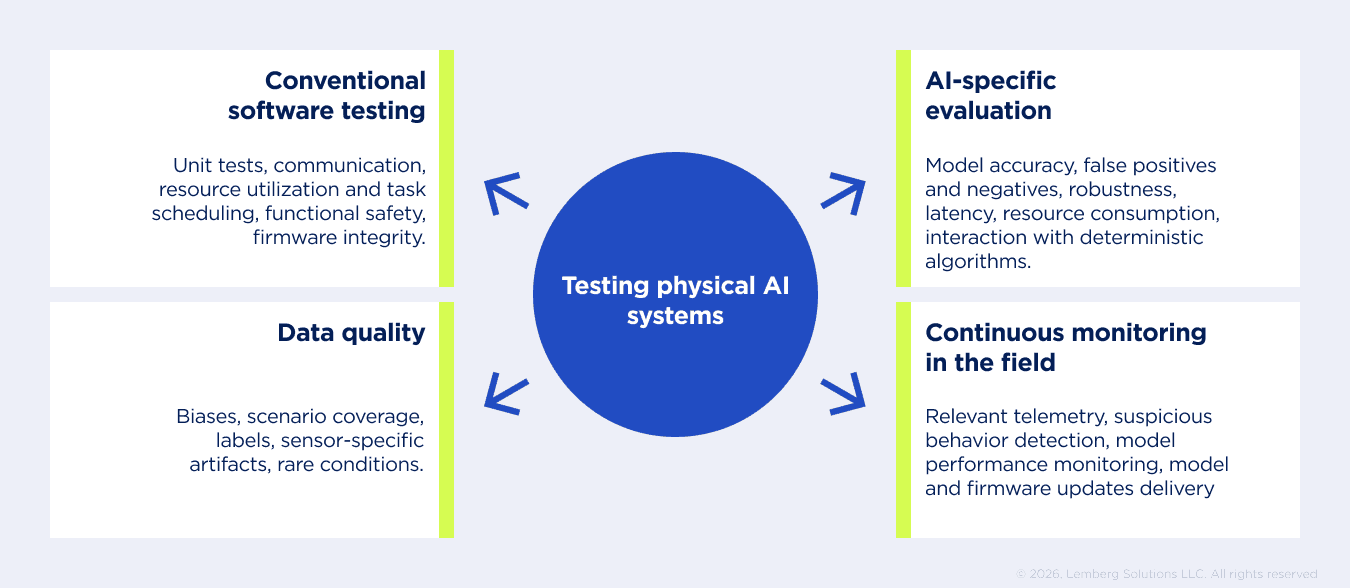
When validating physical AI systems, you are testing a system whose behavior depends on data, trained models, and environmental conditions, as well as probabilistic decisions. Proving that such a system behaves correctly requires a combination of techniques: conventional software testing, AI-specific evaluation, continuous monitoring in the field.
Why Traditional Software Testing Is No Longer Sufficient
Traditional embedded testing can define expected inputs and outputs and verify that the system produces the correct result consistently. AI-based components make this approach harder because there is no single output for every input, and performance can change across different conditions, like lightning, sensor noise, varying object types, or edge cases.
Testing therefore needs to evaluate model accuracy, false positives and negatives, robustness, latency, resource consumption, how AI decisions interact with deterministic control software. For business decision-makers, the important consideration is that passing functional tests does not necessarily mean the physical AI system will behave as expected in real-world conditions.
Data Quality Becomes Part of the Verification Process
The quality and representativeness of the training and test data directly influence AI system behavior. Biases, missing scenarios, incorrect labels, sensor-specific artifacts, or insufficient coverage of rare conditions can produce failures that conventional software testing will not reveal.
Embedded engineers can prevent unexpected behavior by verifying both whether the deployed model works and whether the data used to develop it adequately represents the environments in which the product will operate. Data provenance, dataset versioning, labeling quality, and traceability are the must-have steps in the verification process of physical AI systems.
Validation Continues After Deployment
Even after thoroughly tested, in the field an AI system can encounter combinations of inputs that were not represented during development. Changes in operating environments, sensor characteristics, user behavior, physical surroundings can gradually reduce model performance, which is known as data or concept drift.
To prevent model drift, embedded software includes mechanisms for collecting relevant telemetry, detecting suspicious behavior, monitoring model performance, and safely delivering model or firmware updates when necessary. This turns validation from a one-time pre-release activity into a lifecycle responsibility: the product must remain observable and verifiable throughout its entire operational lifetime.
Why Solving Physical AI Requires More Than Embedded Expertise
The operation of physical AI systems depends on the interaction of multiple components: AI models, sensors, electronics, firmware, mechanical components, connectivity, cloud or edge infrastructure. Here we explain what helps them work together as a single, reliable physical product.
Building Cross-Disciplinary Engineering Teams
A successful physical AI product requires expertise in various fields, with decisions across the disciplines tightly interconnected. An AI engineer may need a particular sensor resolution or compute capability, while the embedded engineer must determine whether that workload can meet real-time and power constraints. The hardware team, at the same time, must ensure the selected components can support the required performance and lifecycle.
Strong system-level ownership and communication in physical AI teams help synchronize trade-offs around the entire system. Having a cross-functional lead supervising the team will prevent individual optimization efforts from breaking the overall design, like when pursuing a 2% accuracy boost eventually drains the battery too quickly. Properly set communication enables concurrent design and conflict resolution before physical designs are locked in and changes become expensive.
Co-Design Across the Entire Product Lifecycle
Cross-disciplinary collaboration has to start early and continue from concept through deployment and maintenance. Architecture decisions, from sensor selection to edge vs cloud partitioning, eventually define the product's cost, performance, power consumption, safety, and ability to evolve later.
The same applies during production and operation: firmware update mechanisms, model deployment, telemetry, cybersecurity, diagnostics, hardware lifecycle management need to be considered before the product reaches the field. Early architectural decisions must account for the entire lifecycle, as changing one layer later can have costly and time-consuming consequences on other levels.
Conclusion
Embedded software for physical AI must bridge probabilistic AI with deterministic physical control, deliver AI within strict hardware and power constraints, and ensure that intelligent behavior remains reliable and safe in real-world conditions.
At the same time, data quality, real-world testing, continuous monitoring, lifecycle updates — all become part of the engineering responsibility, requiring the participating teams to collaborate in sync rather than work sequentially. Successful physical AI is a result of a systems-engineering approach in which embedded software provides the reliable foundation for safe and predictable AI operation in the physical world.

The Most Comprehensive IoT Newsletter for Enterprises
Showcasing the highest-quality content, resources, news, and insights from the world of the Internet of Things. Subscribe to remain informed and up-to-date.

New Podcast Episode

Building Real-Time Voice AI Experiences

Related Articles