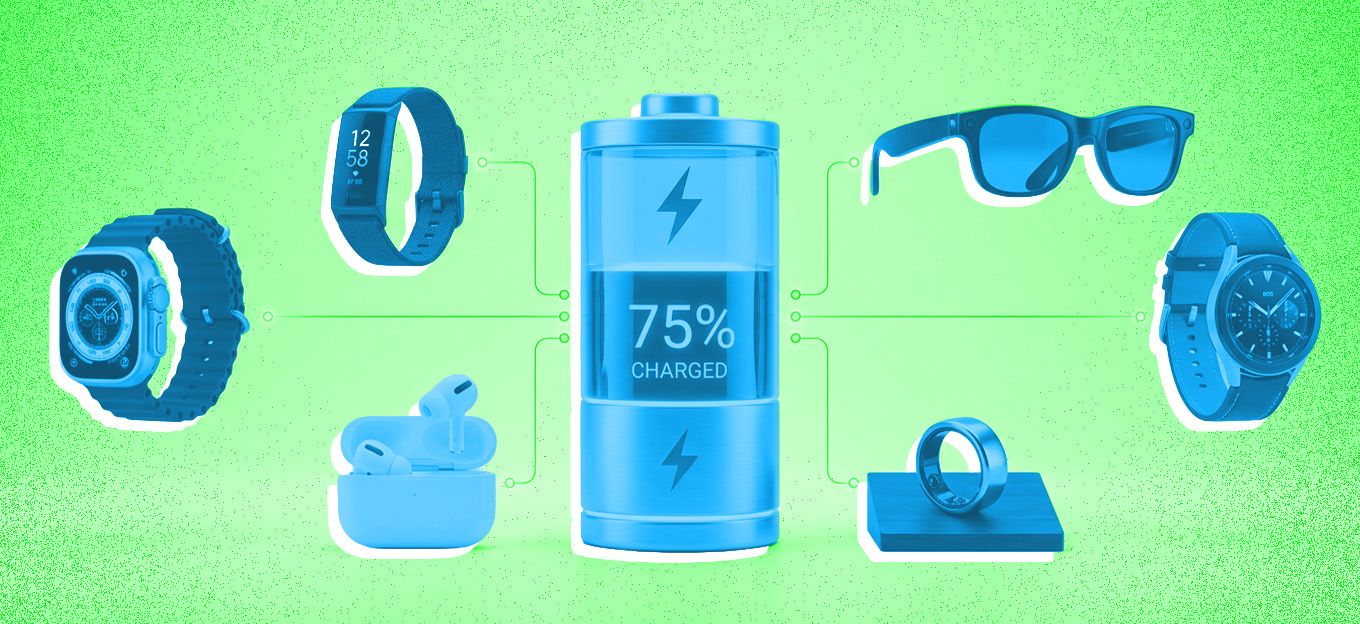
Battery Optimization Challenges in Wearable IoT Devices
Battery Optimization Challenges in Wearable IoT Devices

- Last Updated: May 22, 2026
Shradha Puri
- Last Updated: May 22, 2026

Wearables have gone far beyond their humble beginnings of just being activity trackers to evolve into extremely powerful computing systems that can do everything from measuring your heart rate and sleep to monitoring HRV and stress.
The Apple Watch, Fitbit, Whoop, and even the Oura Ring can track your temperature and warn you if you start showing symptoms of a sickness. However, there is one limiting factor involved: their battery power.
Unlike smartphones, wearables must be lightweight and comfortable enough to wear 24/7. Because of their small size, this makes space for bulky batteries virtually nonexistent.
At the same time, users expect continuous tracking and real-time insights. This creates a difficult engineering trade-off- more features demand more power, but the battery cannot grow in a small form factor.
The result is that one of the biggest challenges in modern wearable IoT is efficient use of their battery without compromising accuracy or user experience.
Why Battery Optimization Is So Critical
Battery optimization in wearable IoT devices directly impacts customer experience and reliability; it isn’t just about convenience. Wearables are designed for continuous sensing and connectivity. They track various health metrics throughout the day and consume energy, which can drain a small battery very quickly.
At the same time, users expect a longer battery life and fast charging because we are simply tired of lugging around wires everywhere we go. Frequently charging breaks the core promise of effortless and continuous monitoring that wearable tech offers.
In fact, I can attest to the fact that poor battery life is one of the top reasons many users abandon their wearable devices. My Apple Watch has been sitting on my nightstand for a week now.
The Core Engineering Challenges
#1: Limited battery capacity
Wearable devices have size limitations. For instance, the average battery capacity of a smartwatch ranges between 130 mAh and 400 mAh, which is considerably lower compared to that of smartphones. The challenge becomes increasingly difficult as devices get thinner and lighter, and design improvements often reduce available battery space.
#2: Continuous Data Sensing
Today’s smart wearable devices have the capability to gather and analyze data simultaneously. This is made possible with functions such as HRV, sleep analysis, stress analysis, and Edge AI. The result is an increase in power consumption, particularly when devices emphasize local processing rather than cloud processing.
#3: Wireless Communication Overhead
Power consumption due to data transfer forms one of the most significant challenges for IoT devices. Wearable devices depend on Bluetooth Low Energy (BLE), Wi-Fi, and cloud syncing. Even with the efficiency of the protocols used, frequent syncing and retransmissions, especially when network connections are bad, can cause rapid energy loss.
#4: Environmental Impact on Battery Performance
Battery performance is very much dependent on the environmental conditions. The higher the temperature, the faster the chemical reactions. It improves the short-term performance but decreases the battery health in the long term. Whereas low temperatures increase internal resistance, limiting its effectiveness and energy storage capacity. For wearables used outdoors or during workouts, these fluctuations are unavoidable, making battery reliability harder to maintain.
#5: Multi-State Power Consumption
Wearable devices have many modes of operation, including the Active Mode, where it runs all-day tracking, Always On Display, or Idle/Sleep Mode. However, achieving accurate optimization of the battery while alternating between these modes is challenging yet crucial to increasing battery life.
#6: Accuracy vs Power Trade-Off
Higher accuracy often requires more frequent sensor sampling and continuous monitoring, but all of these require increased power consumption. Engineers need to optimize between the two, particularly in medical wearable devices.
Key Technologies Enabling Battery Optimization
Dynamic Power Management
Dynamic power management makes sure that only necessary components are active when needed. These techniques include:
- Dynamic Voltage and Frequency Scaling (DVFS)- adjusts processor power based on workload
- Clock gating- disables inactive circuits
- Sleep modes- reduce energy use during inactivity
Sensor Optimization
Wearables contain sensors that are high-energy consumers. Energy management techniques include:
- Duty cycling– sensors switch on when needed
- Adaptive sampling– sampling rates depend on user activity
- Context-aware sensing– sensing is minimized when unnecessary
For instance, a wearable might reduce sampling of heartbeats while at rest and increase sampling when exercising.
Efficient Power Management ICs (PMICs)
Power Management Integrated Circuits (PMICs) play a critical role in energy efficiency. They manage battery charging, voltage regulation, and power distribution. Innovations like single-inductor multiple-output (SIMO) regulators allow multiple voltage rails from a single inductor, saving on both space and energy.
Low-Power Communication Protocols
Bluetooth Low Energy (BLE) and other protocols have been engineered to achieve high efficiencies in the IoT. Other methods of optimizing power consumption include data compression before sending data, batch synchronization instead of constant synchronization, and data processing on devices using Edge AI rather than cloud servers. Reducing wireless communication frequency can dramatically extend battery life.
Battery Testing, Profiling, and Emulation
Efficient wearable batteries do not depend only on their hardware design but also greatly on testing and simulations.
Battery Profiling
Battery profiling deals with how the battery works under different situations, such as changing load conditions and temperatures. This process helps identify capacity, internal resistance, and performance over time.
Battery Emulation
The idea of using emulation instead of actual testing with physical batteries lies in achieving a faster pace of work, enhanced safety of the experiment, and replicable results. This makes it possible to test many situations without charging/discharging.
Long-Term Cycle Testing
This type of battery testing involves the imitation of years of wearables’ life through repeating many charge/discharge processes. The goal here is to identify the performance and capacity loss, as well as battery lifespan restrictions.
Emerging Solutions: Beyond Traditional Batteries
Energy Harvesting for Wearables
Another interesting development is the concept of energy harvesting. What if wearable devices derive power from body heat, movement, or sunlight? Not enough to eliminate batteries at this point, but they do prolong battery lifespan considerably.
Supercapacitors
Supercapacitors enable rapid charging cycles and more longevity. Although they provide better durability, supercapacitors still lag behind lithium-ion batteries in terms of energy density. Combining the two could be a future direction.
Energy Management with Artificial Intelligence
It has become common practice to use artificial intelligence for effective energy management. The use of AI technology allows for the prediction of user activities and the control of sensors based on these predictions.
Software’s Role in Battery Efficiency
Battery optimization isn’t only a hardware problem; software plays an equally important role. Some methods for achieving better optimization include:
- Event-driven processing- tasks run only when triggered
- Efficient scheduling- minimizes processor wake-ups
- Edge AI optimization- reduces cloud dependency
- Memory optimization- lowers computational load
A well-designed firmware can significantly extend the battery life of wearable devices without changing the hardware.
The User Experience Factor
The battery capacity determines how consumers experience using the wearable device. When battery capacity is low, tracking disruptions occur, and people become frustrated by having to frequently charge the battery. On the other hand, optimized batteries help to provide continuous 24/7 monitoring, allowing people to learn more about their health status and be engaged for a long time. This is why battery optimization determines the success factor of a wearable as much as it is an engineering goal.
Future Outlook
The future of battery optimization in wearable IoT devices will likely focus on ultra-low-power AI chips, hybrid energy systems (battery + harvesting), smarter PMIC architectures, and advanced battery chemistries (solid-state, lithium-sulfur). With the growth of the field in the direction of using wearable devices in healthcare, industrial safety, and monitoring, energy efficiency will become ever more important.
It is essential to emphasize that efficient batteries in wearable IoT products are types of problems that can never be solved on their own, but rather require a holistic approach that incorporates different sciences, such as engineering and software development. Power efficiency of wearables will be essential in healthcare, industry, and diagnostics.

The Most Comprehensive IoT Newsletter for Enterprises
Showcasing the highest-quality content, resources, news, and insights from the world of the Internet of Things. Subscribe to remain informed and up-to-date.

New Podcast Episode

Building Real-Time Voice AI Experiences

Related Articles