



Why BESS is the Missing Link in the Renewable Revolution
Why BESS is the Missing Link in the Renewable Revolution

- Last Updated: September 2, 2026
Integra Sources
- Last Updated: September 2, 2026
The global transition to green energy faces a stubborn, physical paradox: the sun doesn’t always shine when the factories are running, and the wind doesn’t always blow when the city lights flicker on. This intermittency gap has long been the Achilles' heel of renewables, forcing grids to rely on carbon-heavy plants to maintain stability.
However, a quiet hardware revolution is unfolding within shipping-container-sized units known as battery energy storage systems (BESS).
Beyond being just giant power banks, modern BESS units are sophisticated feats of mechatronics and software engineering. They are the digital shock absorbers of the electrical grid, capable of injecting megawatts of power in milliseconds to prevent blackouts or shaving peak loads to save millions in infrastructure costs. The BESS sector is expanding at a breakneck pace. According to Benchmark Mineral Intelligence, global installations across grid-scale and behind-the-meter markets hit approximately 315 GWh—a staggering 50 percent year-on-year surge.
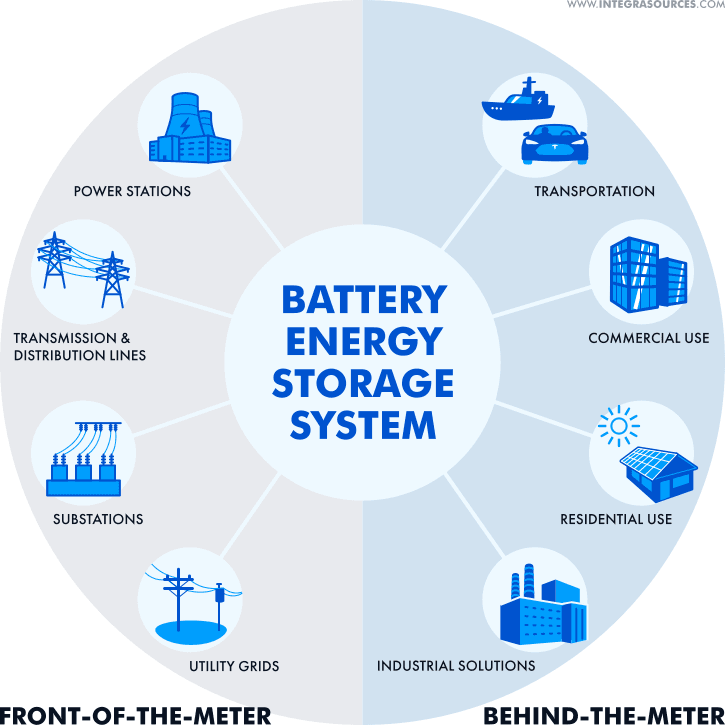
Applications of battery energy storage systems
But as we scale to hundreds of gigawatt-hours, the engineering challenges shift from simple chemistry to complex systems integration. From the nuances of battery management systems that prevent thermal runaway to the AI-driven energy management systems that predict market fluctuations, building a reliable BESS is no longer just about choosing the right cells—it’s about mastering the synergy between electrochemical limits and digital precision.
The Anatomy of a BESS
At its core, a battery energy storage system is an electrochemical buffer. It captures energy from the grid or renewables and stores it for strategic discharge. However, transforming a stack of batteries into a grid-scale asset requires a sophisticated multi-layer architecture where hardware and software converge.
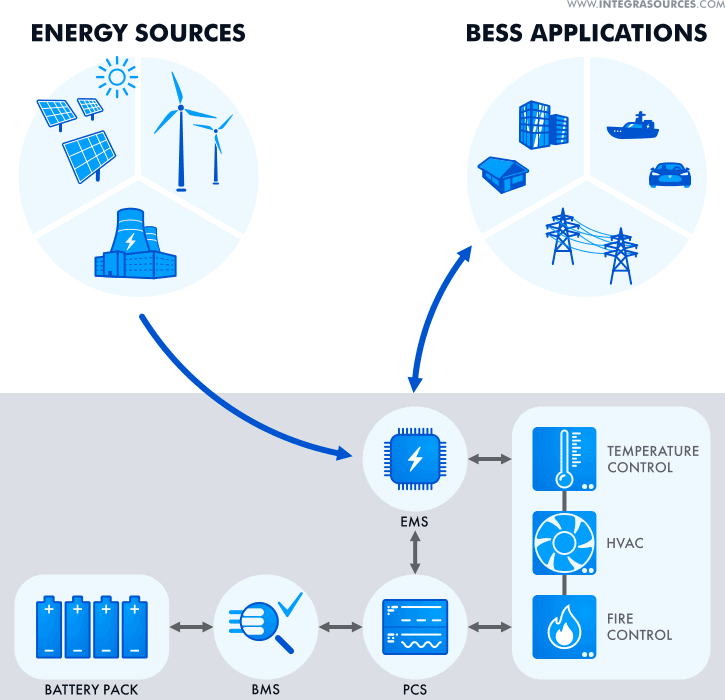
The architecture of a battery energy storage system
The system’s physical foundation starts with battery cells, which are grouped into modules and packs.
These cells are controlled by the battery management system (BMS). The BMS acts as the primary safety layer, monitoring critical parameters like State-of-Charge (SOC) and State-of-Health (SOH) in real-time to prevent thermal runaway and other dangers.
To interact with the AC world of our homes and industries, the BESS relies on a bi-directional power conversion system (PCS). This inverter technology handles the seamless transition between DC storage and AC delivery, enabling both charging and discharging.
The “brain” of the operation is the energy management system (EMS). While the BMS protects the batteries, the EMS manages the entire system’s performance.
Beyond these core units, industrial-grade BESS enclosures integrate advanced HVAC, fire suppression, and environmental monitoring to maintain the delicate thermal balance required for electrochemical stability.
How BESS Stabilizes the Modern World
The true value of a BESS lies in its versatility. Unlike traditional storage solutions that require specific geography—such as massive water reservoirs for pumped hydro—battery systems are modular and location-agnostic. This flexibility allows them to serve as the “Swiss army knife” of the electrical grid, performing several mission-critical roles.
- Demand Orchestration: BESS units mitigate the volatility of electricity pricing through peak shaving. By charging during off-peak hours when demand and cost are low and discharging during peak periods, they flatten the price curve.
- Grid Health: Maintaining a stable frequency in the grid is a constant balancing act. If generation doesn’t perfectly match demand, the grid can fail. BESS provides a sub-second frequency response to power interruptions and maintains the required voltage levels.
- Black-Start and Backup Power: In the event of a total grid collapse, BESS offers black-start capability. Unlike solar or wind alone, which require an active grid to function, a BESS can provide the initial “spark” to restart power plants without external assistance. For commercial facilities, they act as industrial-scale backup power suppliers, eliminating downtime.
- The Renewable Catalyst: Renewables are projected to account for 43% of global generation by 2030, but their intermittency remains a hurdle. Projects from the Faroe Islands to Rokkasho, Japan, prove that BESS is the enabling technology for high-penetration wind and solar. By storing excess daytime solar or nighttime wind, BESS transforms intermittent weather into a dispatchable, 24/7 resource.
- Transmission and Distribution Deferral: It is perhaps the most overlooked benefit. Instead of spending billions to upgrade aging, overloaded power lines, utility companies can strategically place BESS units to store excess energy.
The Chemistry of Storage
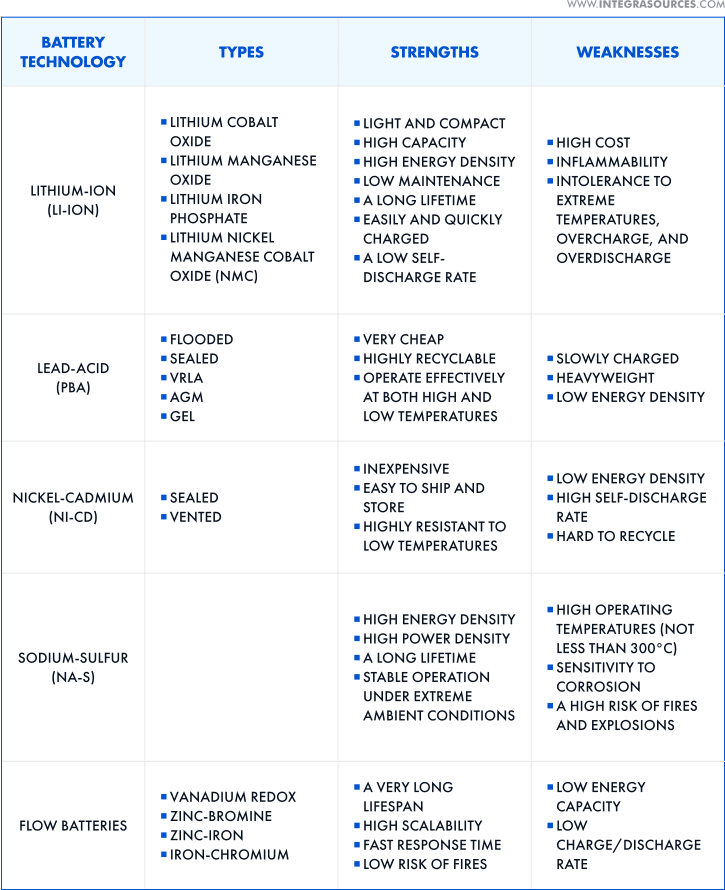
Modern BESS performance is fundamentally limited by battery chemistry. Currently, Lithium-ion dominates about 83-88% of the large-scale market, which is driven by its high energy density, low self-discharge rate, compactness, long lifetime, and other benefits, though engineers must still account for its sensitivity to extreme temperatures and the risk of thermal runaway.
For applications where budget outweighs weight, energy density, and charging time, lead-acid (PbA) remains a viable, highly recyclable alternative. Similarly, nickel-cadmium (Ni-Cd) and nickel-metal hydride (Ni-MH) offer robust performance in low-temperature environments where other chemistries falter. Sodium-sulfur (Na-S) provides impressive power density and long lifetime but requires operating temperatures above 300°C, complicating system design.
However, the most promising shift for long-duration storage lies in flow batteries (such as vanadium redox). By storing energy in liquid electrolytes rather than solid electrodes, they offer a 30-year operational life and near-infinite scalability, presenting a non-flammable solution for the next generation of massive, on-grid storage. On the other hand, they lack energy capacity and charge/discharge rate.
The Engineering Trade-offs: Custom vs. Off-the-Shelf Storage
When scaling energy storage, engineers face a classic dilemma: the speed of “plug-and-play” off-the-shelf units versus the surgical precision of a custom-built BESS. While a ready-made containerized solution is the fastest path to deployment, it is often a “black box” that may not survive specific operational stresses or unique environmental constraints.
Standard units are built for the average grid. However, for specialized applications, such as high-altitude mining operations, arctic telecommunications, or ultra-fast frequency regulation, standard cooling and firmware may fall short.
A custom BESS allows for software tuning that can extend battery life. By developing specialized firmware for the BMS, engineers can optimize cell balancing algorithms specifically for the chosen chemistry or operational conditions. This granular control allows the system to manage SoH, SoC, and other parameters more intelligently, avoiding the aggressive charging cycles that lead to premature degradation in generic systems.
One of the steepest barriers to custom development isn't electrical—it’s regulatory. A bespoke system is not just a collection of components; it is a critical infrastructure asset. Engineers must navigate a dense web of international and local standards, including IEEE 1547 for grid interconnection, as well as IEC 62619 and UL 9540 for safety. In the US, compliance involves the FERC and DOE, while specific sectors, like marine energy storage, must follow DNV recommended practices.

These standards dictate everything from the thickness of the enclosure steel to the response time of the emergency shutdown systems. In a custom build, these regulations must be treated as primary design constraints from day one, not as an afterthought.
Critical Engineering Challenges in Custom Design
Building a BESS from the ground up is a multidisciplinary marathon. It requires a synergy between power electronics, embedded software, and mechanical engineering. One should expect four major technical hurdles:
- Measurement Precision: One of the most significant hurdles in BESS design is the "flat" voltage curve of Lithium Iron Phosphate (LiFePO4) batteries. Unlike other chemistries where voltage drops predictably as the battery drains, LiFePO4 maintains a nearly constant voltage across most of its discharge cycle. Therefore, tiny measurement errors can lead to massive inaccuracies in State-of-Charge estimation. If the system overestimates remaining capacity, it can lead to over-discharge, permanently damaging the cells. Conversely, underestimation leaves expensive energy locked and unusable, reducing the system's ROI.
- The 10-Year Safety Marathon: Industrial BESS assets are expected to operate for a decade or more. Maintaining safety over this lifespan is not a simple task, especially for Li-ion-based solutions. Engineers must design monitoring systems that don't just react to high temperatures, current, or voltage, but actively predict them.
- Thermal Management and Heat Dissipation: Large-scale storage generates immense heat during rapid discharge. Designing an effective HVAC or liquid cooling system is critical to prevent thermal runaway. A custom design allows for optimized airflow paths within the enclosure, ensuring that no single module becomes a hotspot.
- Balancing Issues: Various reasons create imbalance in different battery packs’ remaining energy. Even cells from the same batch have slight variations. Over thousands of cycles, these differences grow. Custom BMS software allows for sophisticated active balancing, where energy is transferred from stronger cells to weaker ones, rather than simply being bled off as heat through resistors.
How AI Unlocks BESS Potential
As battery energy storage systems scale globally, the challenge shifts from simple hardware capacity to operational intelligence. In a volatile energy market defined by the intermittency of wind and solar, a “static” battery is an underutilized asset. Artificial Intelligence may become the key to transforming these systems into dynamic, profit-optimizing participants in the smart grid. Here is how it can affect BESS.
- Dynamic Cycle Optimization: Traditional storage systems often follow fixed charge/discharge schedules. AI replaces this with real-time responsiveness. By analyzing a triad of data streams—weather forecasts, grid stability metrics, and fluctuating market prices—AI-driven systems decide precisely when to draw power. They can identify opportunities to charge when electricity is cheapest and discharge during peak demand, maximizing ROI while minimizing reliance on fossil-fuel backup.
- Predictive Maintenance and Asset Longevity: Battery degradation is a multi-million dollar concern. AI enhances the State of Health (SOH) monitoring by identifying early-stage anomalies such as micro-fluctuations in voltage or subtle overheating long before they trigger a hardware alarm. This shift from reactive to proactive maintenance doesn't just prevent downtime; it extends the chemical life of the battery packs by avoiding unnecessary stress and “wear and tear” during volatile market events.
- Grid Integration in a Decentralized Landscape: As we move toward a decentralized energy model with multiple renewable energy sources, the grid becomes increasingly complex to balance. AI-powered BESS units act as stabilizers that anticipate the needs of the grid and dynamically adjust energy flows to maintain stability.
Evolution of BESS
The evolution of battery energy storage systems represents a fundamental shift in how we conceptualize the electrical grid. No longer a static network of one-way transmission, the grid is becoming a fluid, responsive ecosystem where BESS acts as the critical interface.
Combining the raw power of advanced electrochemistry with the precision of AI-driven management has the potential to effectively de-risk the transition to 24/7 renewable energy. For the modern engineer, the challenge has moved beyond simply storing energy; it is now about orchestrating subsystems with microsecond accuracy to ensure global energy resilience.

The Most Comprehensive IoT Newsletter for Enterprises
Showcasing the highest-quality content, resources, news, and insights from the world of the Internet of Things. Subscribe to remain informed and up-to-date.

New Podcast Episode

Building Real-Time Voice AI Experiences

Related Articles



Related Solutions

Power Plant Safety for Operators
Deploy instant, AI-powered monitoring across power generation facilities with a portable, plug-and-play solution.
Deploy instant, AI-powered monitoring across power generation facilities with a portable, plug-and-play solution.
Iveda
Iveda
Energy Metering for Utilities
Unified metering for electricity, water, oil, and gas to reduce costs, improve efficiency, and support ESG reporting.
Unified metering for electricity, water, oil, and gas to reduce costs, improve efficiency, and support ESG reporting.
akenza
akenza


Smart Metering for Infrastructure
Automated meter readers for gas, water, and electric to enable accurate billing, simplified sub-metering, and insights.
Automated meter readers for gas, water, and electric to enable accurate billing, simplified sub-metering, and insights.
Smarter Technologies
Smarter Technologies

Related Solutions
Utilities
Power Plant Safety for Operators
Deploy instant, AI-powered monitoring across power generation facilities with a portable, plug-and-play solution.
Iveda
Utilities
Energy Metering for Utilities
Unified metering for electricity, water, oil, and gas to reduce costs, improve efficiency, and support ESG reporting.
akenza
Utilities
Smart Metering for Infrastructure
Automated meter readers for gas, water, and electric to enable accurate billing, simplified sub-metering, and insights.
Smarter Technologies