Why Edge AI Is Moving Into the Wireless Chip Itself
Why Edge AI Is Moving Into the Wireless Chip Itself

- Last Updated: September 7, 2026
T2M Semi
- Last Updated: September 7, 2026

For most of the smart device era, "AI" in a connected product meant sending data to the cloud, running inference on a server, and sending a result back. That round trip worked well enough when the task was tolerant of a little latency and a reliable internet connection could be assumed.
Neither assumption holds for a growing share of today's connected devices, and that's driving AI processing directly onto the wireless SoC itself — not as a separate chip, but integrated into the same silicon handling connectivity.
Why Cloud-Only AI Stopped Being Good Enough
Three practical problems pushed AI processing toward the edge:
Latency matters more than cloud round-trips can deliver. A security camera that needs to distinguish a person from a passing car, or a voice-enabled device responding to a wake word, needs a response measured in milliseconds — not the hundreds of milliseconds a round trip to a cloud server typically adds.
Connectivity can't always be assumed. A device that only functions with a live internet connection is a device that fails during an outage, in a location with poor connectivity, or the moment a home router needs a restart. For anything security- or safety-adjacent, that's a real reliability gap.
Continuous cloud inference has real bandwidth and cost implications. Streaming raw sensor or video data to the cloud for every inference, at scale across millions of deployed devices, is expensive in both bandwidth and cloud compute cost — processing locally and only sending meaningful results upstream is dramatically more efficient.
Privacy expectations have shifted. For applications like in-home cameras or audio devices, processing sensitive data locally rather than streaming it continuously to a cloud server has become a genuine product differentiator, not just a technical preference.
What "Edge AI SoC" Actually Means at the Silicon Level
Integrating AI capability into a wireless SoC involves more than adding a faster processor. A few architectural elements define what makes a chip genuinely capable of useful edge inference:
Dedicated AI acceleration, not just a faster general-purpose CPU. Running neural network inference efficiently benefits enormously from hardware specifically designed for the matrix operations that dominate AI workloads — a general-purpose CPU can technically run inference, but at a fraction of the efficiency of purpose-built acceleration.
Memory architecture matched to model size. On-device AI models need to fit within the SoC's available memory, and efficient memory utilization directly determines what model complexity — and therefore what task accuracy — a given chip can realistically support.
Power efficiency for always-on operation. Many edge AI use cases (wake-word detection, presence sensing, anomaly detection) require the AI processing to run continuously, not just when triggered — making power efficiency during inference just as important as processing capability itself.
RISC-V's growing role. A significant share of newer edge AI-capable wireless SoCs are built on RISC-V architectures, partly for the licensing cost advantages RISC-V offers at volume, and partly because RISC-V's extensibility allows chip designers to add custom instructions tuned specifically for AI workloads without waiting on a proprietary architecture vendor's roadmap.
Where Edge AI Is Actually Showing Up in Products Today
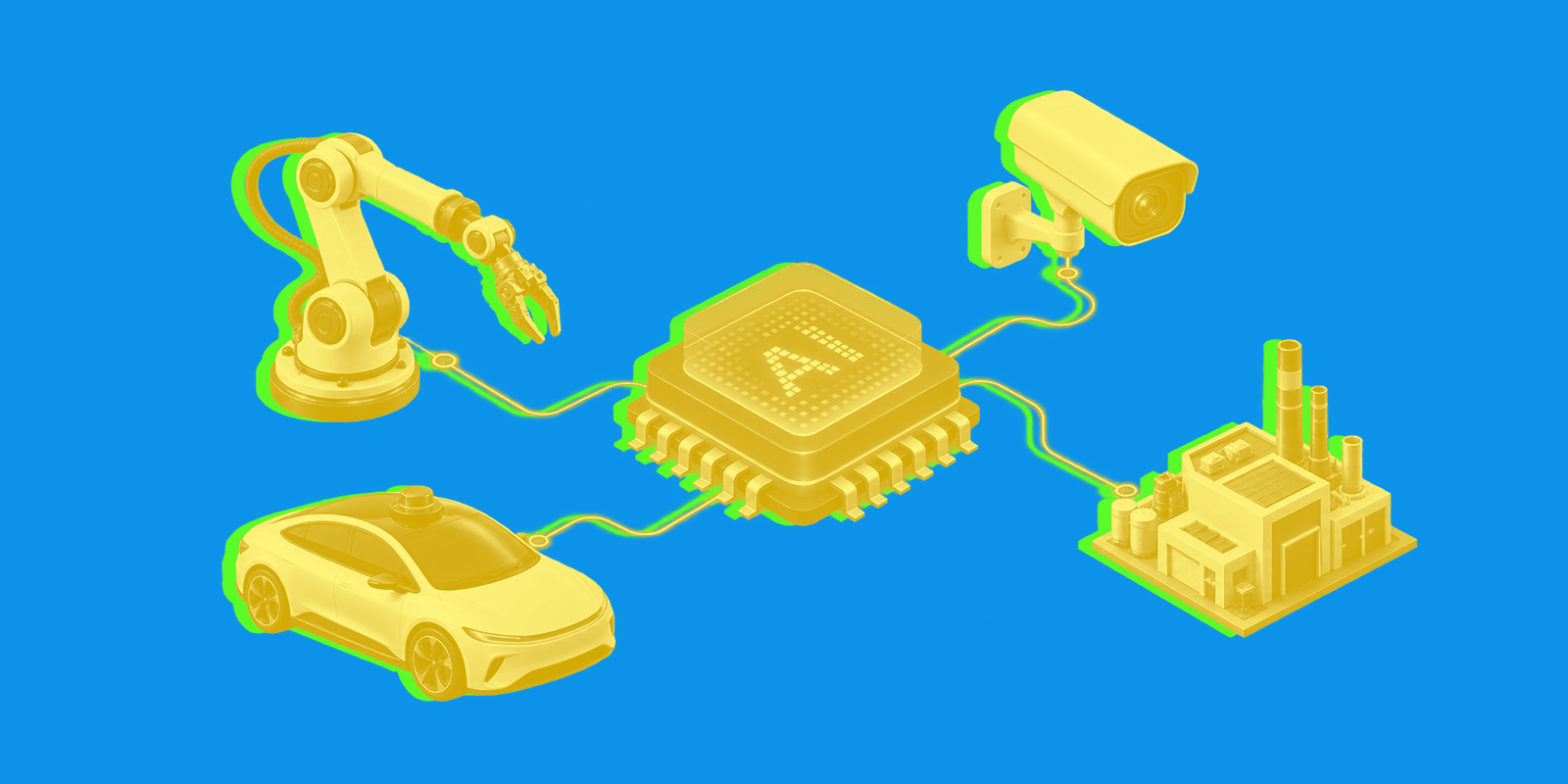
- Security and smart cameras: On-device person/vehicle/animal detection reduces false alerts dramatically compared to simple motion detection, without needing to stream continuous video to the cloud for analysis.
- Voice-enabled devices: Local wake-word detection lets a device stay responsive without continuously streaming audio to a cloud service — audio only gets sent upstream after the wake word is detected locally.
- Industrial and predictive maintenance sensors: On-device anomaly detection in vibration, temperature, or acoustic data allows industrial sensors to flag genuine problems locally, rather than requiring constant cloud connectivity to catch a developing equipment failure.
- Healthcare and wellness wearables: Local processing of biometric data (heart rate patterns, fall detection, activity classification) both improves responsiveness and keeps sensitive health data from needing to transit the cloud for every reading.
- Smart building automation: Occupancy and behavior pattern recognition processed locally allows HVAC and lighting systems to respond in real time without cloud dependency for basic automation logic.
The Practical Tradeoff: Model Complexity vs. Chip Constraints
The honest engineering reality is that edge AI involves real constraints cloud inference doesn't face — a model has to fit within the SoC's memory and processing budget, which means edge-deployed models are generally simpler and more narrowly scoped than their cloud counterparts.
This isn't a limitation to work around so much as a design principle to embrace: edge AI tends to work best for well-defined, narrow tasks (wake word detection, person-vs-not-person classification, anomaly flagging) rather than open-ended general reasoning, which still belongs in the cloud.
A well-designed product architecture increasingly reflects this division of labor explicitly — handling narrow, latency-sensitive, always-on inference locally on the wireless SoC, while reserving genuinely complex, occasional reasoning tasks for the cloud when connectivity allows.
What to Evaluate When Selecting an Edge AI-Capable SoC
For a product team evaluating options, a few questions cut through marketing specs to the details that actually matter:
- What real-world inference latency and power draw does the chip achieve on a model similar in size to what your product actually needs — not just headline TOPS (trillions of operations per second) figures?
- Does the SoC's toolchain support the model formats and training frameworks your team already uses, or does it require retraining models specifically for a proprietary format?
- How does the chip handle the tradeoff between AI processing load and simultaneous wireless connectivity — does inference meaningfully impact radio performance or vice versa?
Looking Ahead
As edge AI silicon continues improving in efficiency, the range of tasks practical to run locally rather than in the cloud will keep expanding. For product teams building the next generation of connected devices, the architectural question is shifting from "should this device have any local AI capability" to "which specific tasks belong at the edge, and which still belong in the cloud" — a more nuanced, and ultimately more useful, design conversation.

The Most Comprehensive IoT Newsletter for Enterprises
Showcasing the highest-quality content, resources, news, and insights from the world of the Internet of Things. Subscribe to remain informed and up-to-date.

New Podcast Episode

Building Real-Time Voice AI Experiences

Related Articles