



Network Selection Behavior Matters: How Non-Steered Roaming Can Improve Battery Life in IoT Devices
Network Selection Behavior Matters: How Non-Steered Roaming Can Improve Battery Life in IoT Devices

- Last Updated: May 5, 2026
WhereverSIM
- Last Updated: May 5, 2026
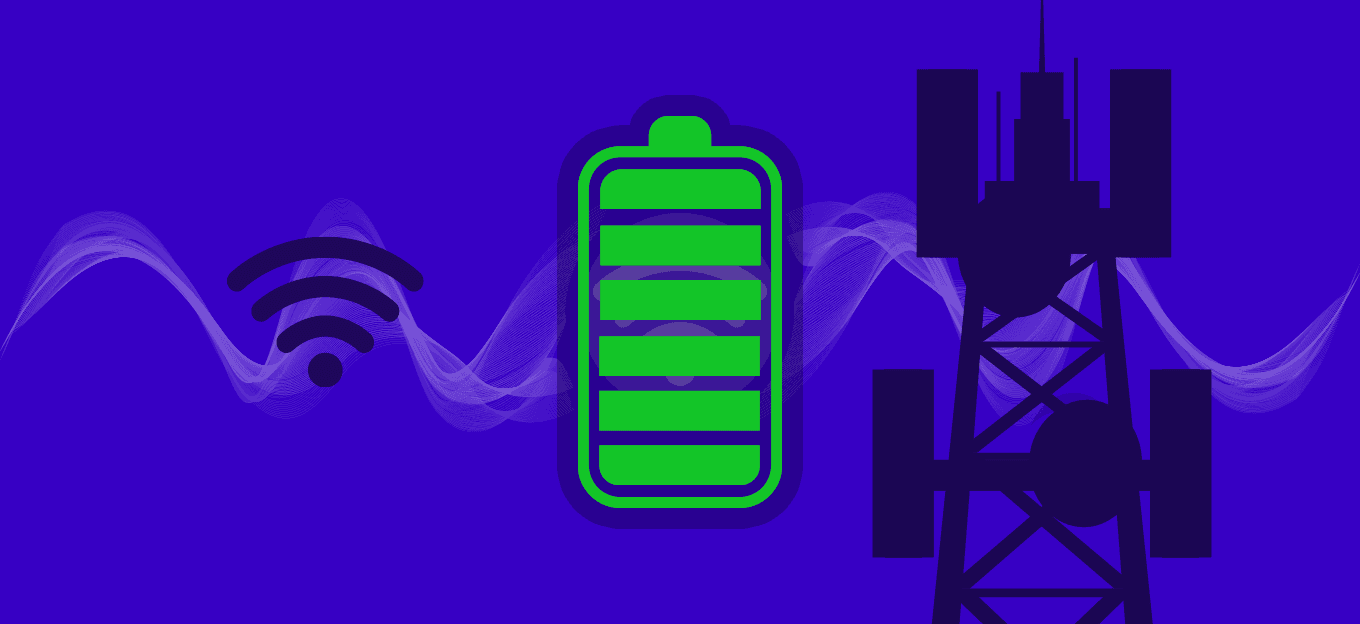
Battery life is one of the most critical design parameters in IoT. Whether it’s a smart meter expected to operate for 10+ years or a remote sensor deployed in a hard-to-reach location, every milliwatt matters.
Most discussions around energy efficiency focus on hardware selection, transmission intervals, or LPWAN features like Power Saving Mode (PSM) and extended Discontinuous Reception (eDRX). While these are, of course, important, there is a factor that is often overlooked:
The way a device connects to the network in the first place.
More specifically, the roaming behavior of the SIM can have a measurable impact on energy consumption, especially in real-world deployments where signal conditions are far from ideal.
Energy Consumption in Cellular IoT: Where It Really Happens
To understand the impact of roaming behavior, it’s important to look at where energy is actually consumed in a cellular IoT device.
Contrary to common assumptions, transmitting user data is often not the primary driver of power consumption, particularly in LPWAN use cases like NB-IoT or LTE-M. Instead, energy is spent on:
- Network scanning and cell selection
- Attach the registration procedures
- Re-attach attempts after connection loss
- Signaling exchanges with the network
Each of these steps requires the modem to power up the radio, synchronize with the network, and exchange signaling messages. If these processes happen frequently – for example, due to unstable connectivity – energy consumption increases rapidly.
LPWAN technologies such as NB-IoT and LTE-M are specifically designed to minimize power usage and can enable battery lifetimes of several years under optimal conditions. However, these efficiencies rely on one key assumption: The device can maintain a stable network connection.
Why Non-Steered Roaming Helps Improve Efficiency
Non-steered roaming removes these constraints as it allows the device to select the most suitable network at the current location instead of forcing it into a prioritized network (steered roaming).
From an energy perspective, this has several advantages.
#1: Faster and More Reliable Network Access
By connecting to the strongest available signal, devices can:
- reduce the number of failed attach attempts,
- shorten the time required to establish a connection, as well as
- minimize network scanning cycles.
This directly lowers the energy required to bring the device online.
#2: Reduced Signaling Overhead
A stable connection reduces the need for:
- frequent re-registrations,
- repeated session setups, and
- additional signaling exchanges.
Fewer signaling events mean less time spent in energy-intensive active states.
#3: Lower Transmission Power
Signal strength has a direct impact on transmission power. With better radio conditions:
- the device can transmit at lower power levels, and
- fewer retransmissions are required.
This is particularly relevant for indoor or deep-indoor deployments, where signal conditions can vary significantly between operators.
#4: Better Alignment with LPWAN Power-Saving Features
Technologies or services like PSM and eDRX are designed to reduce energy consumption by allowing devices to sleep for extended periods.
However, these mechanisms are only effective if the device maintains a stable connection. Frequent reconnect cycles can negate their benefits by forcing the device to wake up more often than intended.
Steered vs. Non-Steered Scenario: A Simple Comparison
To better understand how roaming behavior translates into real-world energy consumption, it helps to look at a simplified but realistic deployment scenario.
Imagine a battery-powered IoT device installed in a challenging radio environment, like a smart meter located in a basement or a sensor deployed in an industrial building. At this location, multiple mobile networks are technically available, but their signal quality differs significantly.
In such environments, devices often operate at the edge of coverage, where small differences in signal strength can have a large impact on connection stability and thus power consumption.
Let’s now compare how the same device behaves under two different roaming configurations:
Device A: Steered Roaming
- Attempts to connect to a predefined preferred network
- Signal quality is poor but still detectable
- Multiple attachment attempts may be required
- Higher transmission power due to poor radio conditions
- Increased likelihood of retransmissions and connection drops
Device B: Non-Steered Roaming
- Selects the strongest available network based on current conditions
- Faster and more stable initial attachment
- Fewer retries and reconnect attempts
- Lower transmission power due to better signal quality
- More efficient and predictable communication cycles
Even if both devices transmit the same amount of data, their energy consumption profiles will differ.
Over the lifetime of a deployment, this can translate into a substantial difference in battery longevity and, in some cases, reduce the expected lifetime substantially.
Where Battery Lifetime Matters Most
The impact of roaming behavior on energy consumption is particularly relevant in use cases where battery-powered devices are expected to operate for many years and physical access for maintenance is limited or costly.
Typical examples are:
- Smart metering: Long battery lifetimes are critical, and devices are often installed in basements or utility rooms
- Industrial IoT: Deployments in complex or hard-to-reach indoor environments
- Smart city infrastructure: Sensors in underground or shielded locations
In these scenarios, even small inefficiencies in connectivity can accumulate over time and impact operational costs.
Today’s Network Environments
The impact of roaming behavior is becoming more relevant as cellular networks continue to evolve. Since the ongoing shutdown of 2G and 3G and the expansion of 4G, 5G, LTE-M, and NB-IoT coverage, behaviors have reached the device level. Instead of relying on a single network layer, devices start operating in environments where multiple technologies and operators overlap.
In practice, this means that signal quality can vary between operators at the same location and that devices increasingly depend on roaming to maintain reliable connectivity. The assumption that a predefined “preferred network” will consistently deliver the best performance in these more dynamic environments no longer holds.
As a result, steering a device toward a fixed operator can lead to repeated inefficiencies such as failed attach attempts, unstable connections, or unnecessary retransmissions – although better alternatives are available.
Allowing devices to dynamically select the best available network is therefore not just about improving connectivity, but it directly impacts how efficiently a device can operate, including how much energy it consumes over time.
Design Considerations for Engineers
For engineers designing IoT solutions, it is worth considering connectivity behavior as part of the overall power optimization strategy.
Some practical recommendations include:
- Evaluate roaming behavior, not just coverage footprint
- Test devices in real deployment environments, not only in lab conditions
- Monitor attach success rates and retry patterns
- Optimize device-side retry logic and backoff mechanisms
- Consider how connectivity interacts with PSM and eDRX configurations
Small Decisions
Battery life in IoT devices is not determined by a single factor but a result of many small decisions across hardware, firmware, and network technology. Roaming behavior is one of those decisions.
There is no universal right or wrong when it comes to steered versus non-steered roaming. Both approaches have their place depending on the use case, commercial setup, or regulatory constraints. But one thing becomes clear: the way a device selects and maintains its network connection has a direct impact on energy consumption.
The good news is that once these mechanisms are understood, they become part of a broader system perspective where connectivity is no longer seen as just “coverage or pricing” but as a lever to improve efficiency and long-term performance.

The Most Comprehensive IoT Newsletter for Enterprises
Showcasing the highest-quality content, resources, news, and insights from the world of the Internet of Things. Subscribe to remain informed and up-to-date.

New Podcast Episode

Building Real-Time Voice AI Experiences

Related Articles




Related Solutions
Mobile Networking for Public Safety
Enable data sharing, enhanced situational awareness, and secure communication across vehicles, devices, and command centers.
Enable data sharing, enhanced situational awareness, and secure communication across vehicles, devices, and command centers.
Digi
Digi
Asset and Inventory Monitoring
Track assets, monitor performance, and maintain persistent connectivity to improve supply chain efficiency, security, and uptime.
Track assets, monitor performance, and maintain persistent connectivity to improve supply chain efficiency, security, and uptime.
Digi
Digi

Primary and Failover Connectivity for Retail
4G/5G cellular networks for enabling uninterrupted retail operations with seamless support and rapid deployment across stores.
4G/5G cellular networks for enabling uninterrupted retail operations with seamless support and rapid deployment across stores.
KORE
KORE

Related Solutions
Smart Cities
Mobile Networking for Public Safety
Enable data sharing, enhanced situational awareness, and secure communication across vehicles, devices, and command centers.
Digi
Supply Chain & Logistics
Asset and Inventory Monitoring
Track assets, monitor performance, and maintain persistent connectivity to improve supply chain efficiency, security, and uptime.
Digi
Retail
Primary and Failover Connectivity for Retail
4G/5G cellular networks for enabling uninterrupted retail operations with seamless support and rapid deployment across stores.
KORE