



Why Your MES Is Blind to Carbon — And How to Fix It
Why Your MES Is Blind to Carbon — And How to Fix It

- Last Updated: June 1, 2026
Alex Vakulov
- Last Updated: June 1, 2026
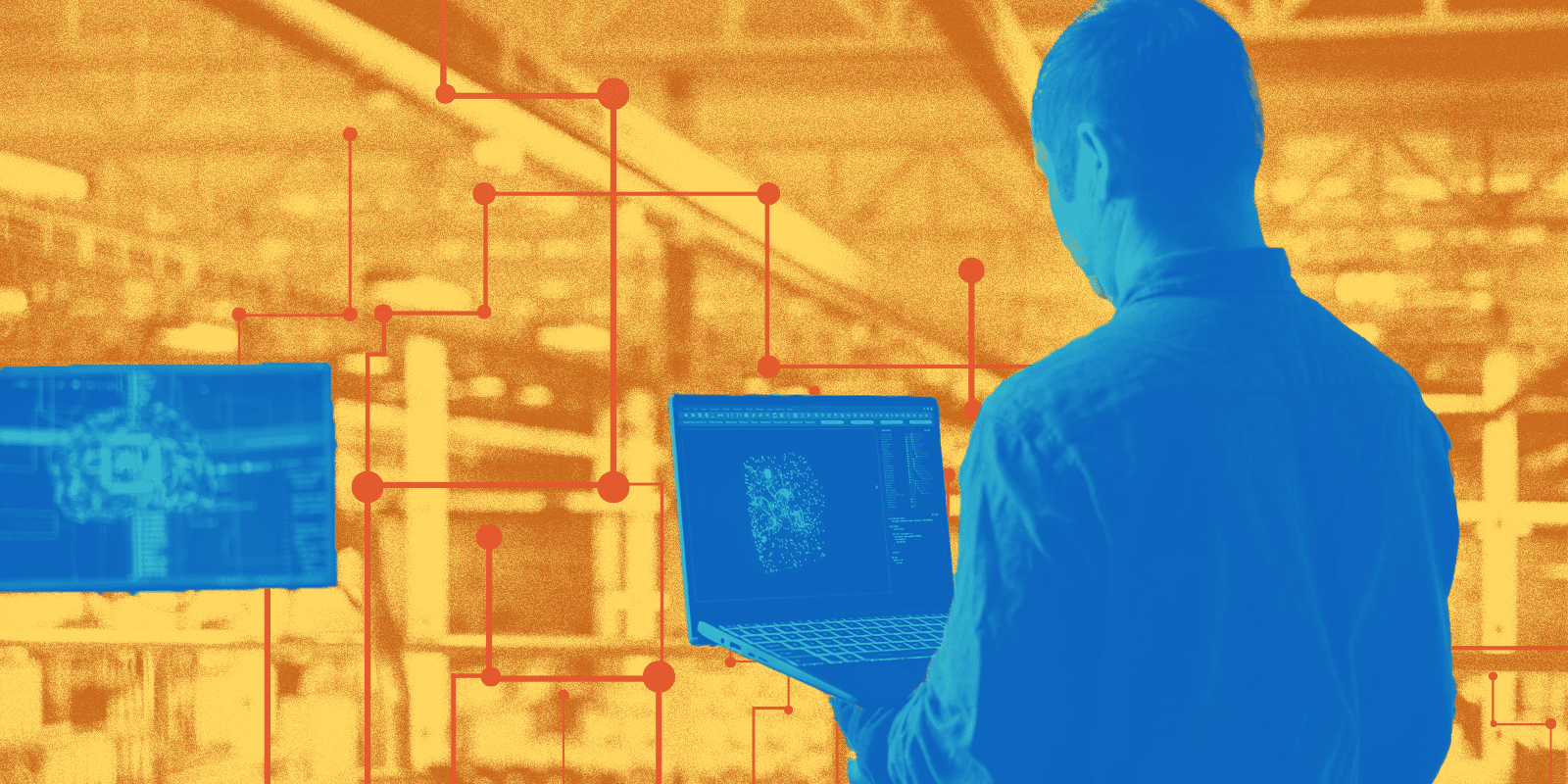
Factories have spent billions instrumenting their production lines with IIoT sensors. Most of that data never reaches the one place it could actually reduce emissions in real time: the Manufacturing Execution System.
When Lesia Yanytska, Chief Product Manager for Manufacturing Execution Systems at Luxoft, began mapping data flows inside large-scale industrial facilities, she kept encountering the same contradiction. Factories were instrumented with thousands of IIoT sensors streaming machine-level energy data in real time. And yet every carbon emissions figure those same factories reported was calculated weeks later, in a spreadsheet, by someone in a corporate sustainability team.
“The data was there,” she says. “It just never went anywhere useful.”
That observation points to one of the most consequential unsolved problems in industrial operations today — and understanding it requires looking not at the sensors, but at what happens to their data after it is collected.
The Gap Is Not a Sensor Problem
Every modern factory floor is instrumented. Motors, compressors, conveyors, and pneumatic systems stream energy consumption data into SCADA systems and programmable logic controllers every few seconds. The connectivity infrastructure for carbon visibility already exists in most industrial environments.
The problem is structural. Energy data flows up from the IIoT layer into operational systems. Carbon data flows down from corporate sustainability teams in quarterly reports. These two streams rarely meet inside the production environment where real-time decisions are actually made.
The result is a factory that knows, in exquisite detail, how much electricity a specific compressor consumed at 3 a.m. — but cannot tell an operator what its carbon intensity was per unit produced during the morning shift without consulting a report assembled two weeks later.
A 2025 peer-reviewed study examined continuous emission monitoring systems across industrial applications and identified this challenge precisely. While sensor technology for measuring CO₂e has advanced substantially, integrating real-time carbon data into operational decision-making systems remains the critical missing link.
The authors call for “real-time, dynamic carbon metering” — carbon accounting using context-specific, machine-level measurements rather than facility-level aggregates — and argue it is both technically feasible and commercially necessary given tightening regulatory frameworks globally.
That regulatory pressure is arriving faster than most manufacturers anticipated. CSRD compliance requirements are expanding across European supply chains. SEC climate disclosure rules are advancing in the United States. Scope 3 accountability — emissions from suppliers — is increasingly a condition of doing business with major manufacturers in automotive and aerospace. The factory that cannot produce an auditable, real-time carbon intensity record per SKU is increasingly the factory that loses the contract.
As Ferdi Aksoy, Senior Director of Asia Pacific Operations at Rockwell Automation, noted in June 2025: “Manufacturers today face increasing pressure to balance production efficiency with sustainability goals. However, many industrial facilities lack the necessary digital tools to analyze energy consumption, predict inefficiencies, and implement corrective measures.”
What Aksoy describes as a tooling gap is, in most facilities, actually an integration gap. The sensors are there. The connectivity is there. Edge computing is there. What is missing is the architectural layer that transforms machine-level energy telemetry into live carbon intelligence inside the system where plant operators actually work.
Why Adding Another Platform Is the Wrong Answer
The instinct of many industrial technology teams when confronted with a carbon data problem is to add another platform — another analytics module, another sustainability dashboard running alongside existing systems.
That instinct creates more complexity without solving the underlying problem.
“A standalone carbon monitoring tool can tell you energy went up,” Yanytska explains. “It cannot tell you that energy went up because you switched to a heavier product variant that runs at a lower speed. The MES knows that.”
The Manufacturing Execution System already sits at the convergence of machine telemetry, production scheduling, quality control, and real-time operational decision-making. It knows what is being produced, on which line, using which recipe, in which shift, at what throughput rate. No standalone sustainability platform has access to that production context — and without it, carbon data is directional at best and misleading at worst. The architectural argument is straightforward: carbon intensity should be calculated and acted upon where production decisions are made, not reported on afterward by a system that was never part of those decisions.
What the Integration Actually Looks Like
Closing the gap between IIoT energy data and MES carbon intelligence does not require ripping out existing infrastructure. It builds on what manufacturers have already deployed.
Data Acquisition
This starts with existing IIoT sensors, energy meters, and SCADA/PLC systems. Standard industrial protocols handle data transport — OPC UA for real-time machine telemetry and MQTT for lightweight sensor messaging from edge devices. In most facilities, no new hardware is required at this layer.
Carbon Calculation
This is where the translation happens. Raw energy consumption data is normalized against dynamic carbon emission factors — the grid carbon intensity coefficients that vary by region, time of day, and energy mix — and translates it into CO₂e per production unit continuously. Not nightly. Not monthly. Per shift, per line, per SKU, updated in real time as production conditions change.
MES Integration
This embeds that calculated figure directly within the MES as a live operational KPI, sitting alongside throughput, quality rate, OEE, and downtime in the same operator interface. When carbon intensity exceeds a defined threshold — because of equipment inefficiency, a process deviation, a recipe change, or a grid carbon spike — the system triggers automated operator alerts. Crucially, it also identifies the probable root cause, so operators know what to fix, not just that something is wrong.
ESG Synchronization
This closes the loop at the enterprise level. Processed carbon data flows via secure API to platforms like SAP Sustainability Control Tower or Salesforce Net Zero Cloud, enabling automated regulatory reporting aligned with GHG Protocol, CSRD, and SEC climate disclosure requirements. The same data that triggered an operator alert during a production shift becomes the auditable record that satisfies a regulatory disclosure requirement.
The result is a manufacturing system that does not measure emissions retrospectively but manages them operationally.
What Happens When the System Actually Finds Something
During a production run at an FMCG manufacturing facility, a carbon intensity monitoring engine registered an anomaly mid-shift. CO₂e per unit had climbed sharply from its established baseline — a deviation that would have been invisible until a monthly facility-level emissions report, with no attribution to cause.
The alert engine identified the root cause within minutes: a pneumatic valve malfunction was causing a compressor to cycle inefficiently. The fault was corrected within 45 minutes. Carbon intensity dropped from 0.87 kg CO₂e per unit to 0.68 — a 22 percent reduction within a single shift.
In a traditional environment, that malfunction burns excess energy for the remainder of the shift, potentially for days until a scheduled maintenance inspection, and the carbon cost accumulates invisibly in the background. An MES-embedded monitoring system makes it visible in real time, during the shift, when something can still be done about it.
This is the practical difference between carbon reporting and carbon management.
The IIoT ROI Argument Gets Stronger
For IIoT practitioners, the most important implication of this architecture is what it does to the economics of sensor deployment.
Research published in Internet Technology Letters on IIoT-integrated carbon monitoring found that implementing a real-time carbon emission sensing network using existing IIoT infrastructure produced measurable decreases in carbon emission intensity at a pilot manufacturing site — without deploying new sensor hardware. The infrastructure investment made for operational efficiency has a sustainability intelligence use case built into it, waiting to be activated.
This changes the business case conversation significantly. Manufacturers have historically justified IIoT sensor deployments on OEE improvement and predictive maintenance grounds. Those remain valid. But when the same sensor infrastructure also satisfies an emerging regulatory requirement for real-time carbon accountability, the ROI calculation looks materially different — and the organizational resistance to sensor investment tends to drop.
Manufacturers facing Scope 1 disclosure requirements have two paths. They can build a separate carbon monitoring infrastructure alongside their existing IIoT stack, or they can integrate carbon intelligence into the MES systems already processing machine-level data. The second path is faster, cheaper, and produces more granular and actionable data than any standalone system could, because it has access to the production context that gives raw energy numbers meaning.
What Implementation Actually Requires
For operations and IIoT teams evaluating whether this is achievable in their environment, the prerequisites are narrower than most assume.
On the infrastructure side: machine-level energy metering at the IIoT layer, industrial protocol support for real-time data transport, and an MES platform with API integration capability. Most facilities that have made meaningful IIoT investments in the last five years meet these requirements already.
On the organizational side: willingness to treat carbon intensity as an operational metric rather than a reporting output. This is often the harder prerequisite. Sustainability metrics have historically lived in finance and compliance functions.
Moving them into operations — into the same daily management system as throughput and quality — requires both a technical integration and a governance decision about who owns the number and what they do when it moves.
As the Heliyon review concluded, the central challenge for real-time industrial carbon metering is no longer sensor technology. It is developing solutions that produce “accurate, actionable carbon data” integrated into operational systems where decisions are actually made.
The IIoT layer already generates that data. The MES is already where those decisions happen. The integration between them is the work that remains — and for most organizations that have made the sensor investment, it is significantly closer to achievable than they think.

The Most Comprehensive IoT Newsletter for Enterprises
Showcasing the highest-quality content, resources, news, and insights from the world of the Internet of Things. Subscribe to remain informed and up-to-date.

New Podcast Episode

Building Real-Time Voice AI Experiences

Related Articles



Related Solutions
RTK Positioning for Robotics and Field Machines
High-precision positioning. Achieve centimeter-level accuracy without the complexity of building custom hardware from scratch.
High-precision positioning. Achieve centimeter-level accuracy without the complexity of building custom hardware from scratch.
Kalmix
Kalmix

Remote Propane Tank Monitoring
Retrofit LoRaWAN® sensor to provide accurate, real-time fuel level readings from R3D-compatible gauges.
Retrofit LoRaWAN® sensor to provide accurate, real-time fuel level readings from R3D-compatible gauges.
EAMS Technologies
EAMS Technologies


Condition Monitoring and Analytics for Industrial Systems
Monitor, maintain, and automate distributed industrial systems using customizable edge-to-cloud intelligence.
Monitor, maintain, and automate distributed industrial systems using customizable edge-to-cloud intelligence.
Pratexo
Pratexo

Related Solutions
Industrial
RTK Positioning for Robotics and Field Machines
High-precision positioning. Achieve centimeter-level accuracy without the complexity of building custom hardware from scratch.
Kalmix
Industrial
Remote Propane Tank Monitoring
Retrofit LoRaWAN® sensor to provide accurate, real-time fuel level readings from R3D-compatible gauges.
EAMS Technologies
Industrial
Condition Monitoring and Analytics for Industrial Systems
Monitor, maintain, and automate distributed industrial systems using customizable edge-to-cloud intelligence.
Pratexo