How Internet Censorship Threatens IoT Systems
How Internet Censorship Threatens IoT Systems

- Last Updated: August 20, 2026
Proton
- Last Updated: August 20, 2026
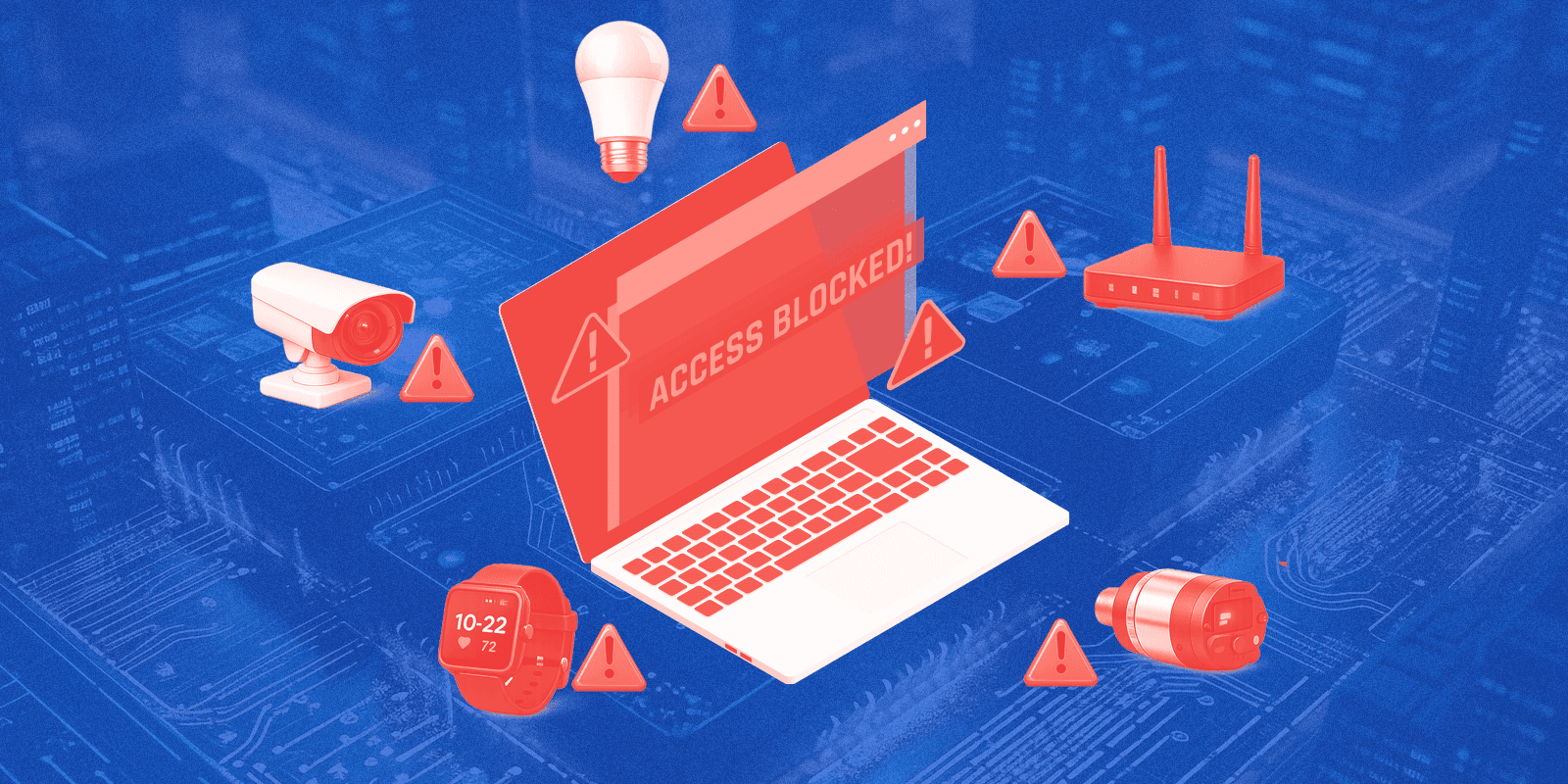
The Internet of Things rests on a simple premise: devices talk to each other across a free and open internet. Smart city sensors stream data to municipal dashboards. Connected medical devices relay patient vitals to healthcare providers. Industrial IoT systems coordinate supply chain logistics in real time. All of this assumes the internet is truly interconnected.
But what happens when it isn't?
According to Freedom House's Freedom on the Net 2025 report, global internet freedom declined for the 15th consecutive year. Of 72 countries assessed, conditions deteriorated in 28 while only 17 saw improvements. China has remained the world's worst environment for internet freedom for over a decade. The report highlights that government manipulation of online information has undergone the most consistent global decline of any indicator measured over 15 years.
For the IoT industry, this is not an abstract policy debate. Internet censorship through website blocking, content filtering, or shutdowns directly undermines the infrastructure that connected devices rely on to function.
When Connectivity Becomes Conditional
IoT devices depend on continuous network access. When governments block services, throttle bandwidth, or sever connectivity entirely, the consequences cascade through the ecosystem.
As IoT For All has explored, urban IoT systems depend on uninterrupted data flows between sensors and central platforms. Traffic signals that adjust in real time, environmental monitoring stations, and smart parking systems all assume that data can move freely.
Now imagine a government-ordered internet shutdown, or targeted blocking of cloud services hosting IoT platforms. Smart infrastructure stops working when the network fails. Emergency alert systems built on IoT frameworks go silent.
Russia has repeatedly shut down mobile internet across large regions, disrupting digital payment systems and IoT-dependent commerce. These shutdowns demonstrate how quickly the absence of connectivity can paralyze the digital economy.
Surveillance Vectors Under Restrictive Regimes
Censorship and surveillance often go together. In environments where governments restrict internet access, the same infrastructure used to enforce blocks can be repurposed for monitoring.
As IoT For All's examination of human rights and IoT notes, the UN has affirmed that "the rights held by people offline must also be protected online." Yet IoT devices generate an unprecedented surveillance surface through location traces, health metrics, and behavioral patterns.
In countries with weak privacy protections, this data can be commandeered. Smart cameras for traffic management can track populations. Connected utility meters reveal occupancy patterns. The smart city digital identity infrastructure creates detailed maps of citizen behavior that authoritarian regimes may exploit.
The importance of privacy in IoT becomes starkly apparent in these contexts.
Security Risks Multiply
Internet censorship reshapes network architecture in ways that introduce vulnerabilities. When legitimate services are blocked, users resort to workarounds like proxy servers and encrypted tunnels. Each introduces new nodes in the network, and if poorly secured, new attack surfaces.
The current state of IoT cybersecurity is already precarious. Many devices ship with default credentials, unpatched firmware, and minimal security. Adding circumvention infrastructure compounds the risk.
Interception inherently weakens the security model that IoT systems depend on. A man-in-the-middle attack becomes easier when the interceptor is the state itself. The same techniques used to censor the internet, including deep packet inspection and DNS poisoning, require intermediaries to intercept and analyze traffic.
Understanding VPN Technology for Censorship Circumvention
Virtual Private Networks serve one core function in restricted environments: they encrypt traffic and route it through servers in locations without censorship restrictions. This allows devices to reach cloud services and APIs that would otherwise be unreachable.
The Electronic Frontier Foundation's Surveillance Self-Defense guide outlines several factors that determine effectiveness: logging policies, jurisdiction, encryption strength, and resistance to deep packet inspection techniques. Not all VPN implementations provide equal protection.
For IoT professionals assessing deployment risks, visualization tools can help identify where connectivity barriers exist. Resources like Proton's internet censorship simulator provide interactive data on which services are restricted in specific countries. Such tools help architects understand regional variations in network access before deploying hardware or designing system architectures.
It is worth noting that VPNs have limitations. Some governments actively block VPN traffic itself, requiring alternative approaches like Tor bridges or domain fronting. Additionally, VPNs do not address all censorship vectors—age verification mandates or application-level restrictions may persist regardless of routing choices. The EFF has written on these limitations in the context of certain regulatory frameworks.
Connectivity resilience should be designed into projects from the start rather than added later. This principle aligns with broader IoT security trends.
Key Actions for IoT Professionals
- Design for degraded connectivity. Edge computing architectures allow devices to process data locally and reduce dependence on cloud services. Build trust into IoT systems by accounting for unreliable or intentionally disrupted environments, as discussed in protecting privacy in IoT.
- Encrypt traffic end-to-end. In censored environments, unencrypted traffic is a target. Securing your IoT device is critical. Strong encryption protects user privacy and device integrity.
- Understand deployment jurisdictions. IoT deployments increasingly span borders. Organizations like OONI provide open data on network censorship worldwide, helping engineers understand where traffic might be blocked or monitored.
The Stakes Are Rising
The intersection of IoT and internet censorship is not a niche concern. It is a fundamental challenge to the connected future. The UN principle that offline rights must be protected online applies with particular force to IoT, where the boundary between digital and physical has dissolved.
Freedom House's finding that internet freedom declined for 15 straight years should alarm anyone whose business depends on connectivity. The human-centric future of IoT hinges on preserving the open internet.
For IoT professionals, internet censorship is an engineering constraint and design consideration that belongs in every project plan.

The Most Comprehensive IoT Newsletter for Enterprises
Showcasing the highest-quality content, resources, news, and insights from the world of the Internet of Things. Subscribe to remain informed and up-to-date.

New Podcast Episode

Building Real-Time Voice AI Experiences

Related Articles