



Warehouse Risk Assessment: A Comprehensive Approach to Racking Safety
Warehouse Risk Assessment: A Comprehensive Approach to Racking Safety

- Last Updated: June 11, 2026
Prylada
- Last Updated: June 11, 2026
According to Eurostat, transport and storage is one of the highest-risk sectors in the EU: in 2023, it recorded 2,366 non-fatal workplace accidents per 100,000 employed people - second only to construction. In the first half of 2024 alone, the European logistics and transportation sector reported 21,926 incidents, including 66 fatalities. These aren't abstract numbers. Behind them are real operations brought to a halt, products destroyed, and workers hurt.
The racking system is at the center of many of these incidents. It's the infrastructure everyone depends on, but few actively manage. And that's exactly the problem this article is about.
Risk Assessment is Not a Compliance Checkbox
Here's the honest version: most warehouse managers know risk assessment is required by law. The EU's Framework Directive 89/391/EEC and national OHS regulations make it mandatory. EN 15635, the standard governing racking inspection and maintenance, sets clear expectations for inspection frequency, damage classification, and response protocols.
But the organizations that get the most value from risk assessment aren't doing it because they have to. They're doing it because they've seen what unmanaged risk costs: damaged goods, structural failures, insurance claims, downtime, and, in the worst cases, serious injuries.
The good news is that a well-run risk assessment isn't a massive bureaucratic exercise. It's a systematic, repeatable process. Here's how it works:
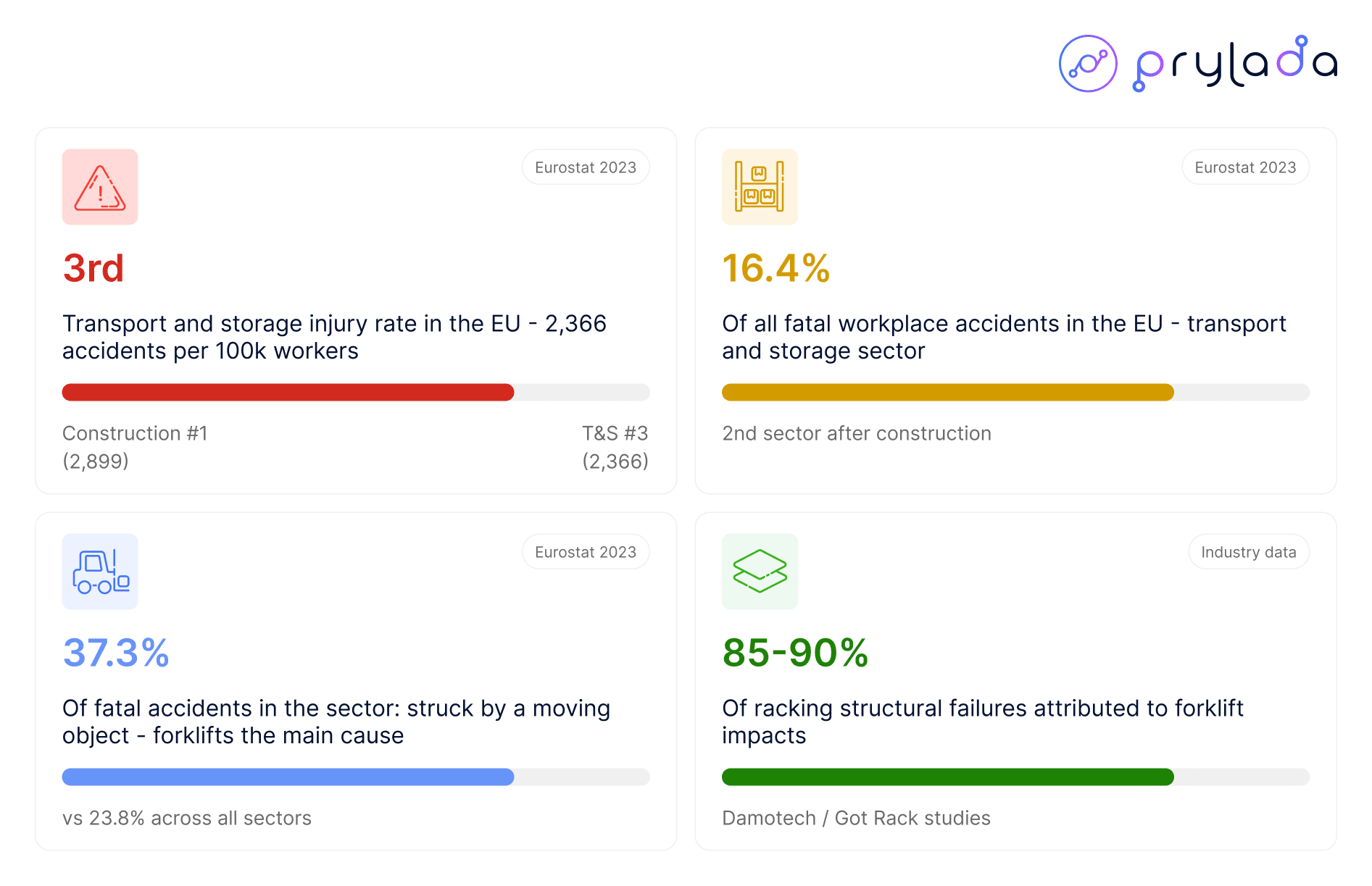
Sources: Eurostat ESAW 2023 — accidents at work by economic activity. Industry figure (85–90%) based on Damotech and Got Rack sector studies.
A systematic approach: five steps that actually work
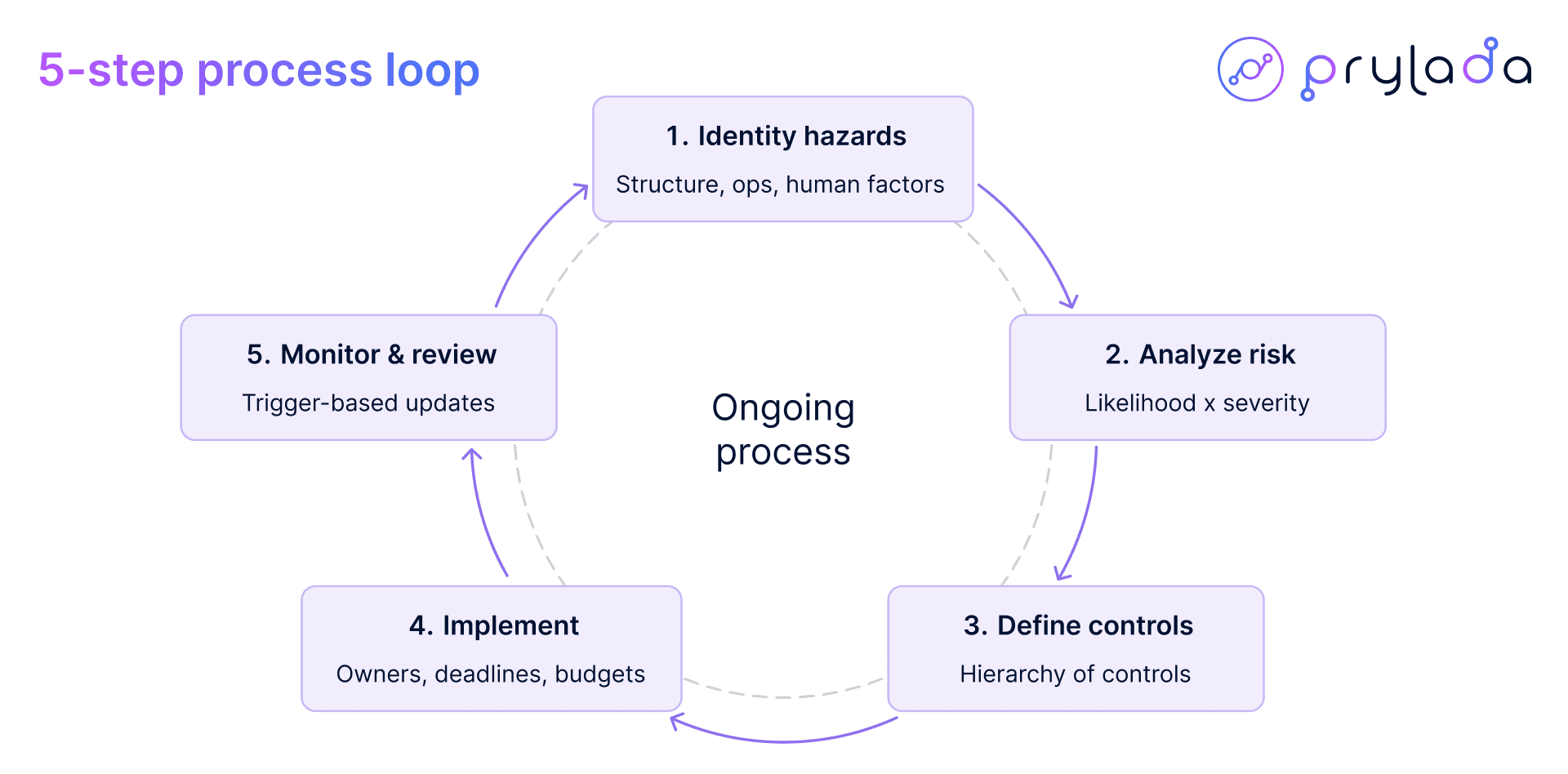
Step 1: Identify Hazards
Before you can manage risk, you need to know what you're dealing with. That means looking at racking from multiple angles — not just a visual walk-around, but a structured review that covers:
- Manufacturer documentation and original load specs
- Any history of incidents, near-misses, or informal damage reports
- Input from the people who work with the racks every day — operators often know where the problems are long before they show up in a report
- Analysis of how forklifts, pallet jacks, and pedestrians interact with the racking layout
Common hazard categories: structural damage (bent uprights, cracked beams, missing safety pins), operational overloads, environmental factors (corrosion in cold stores, vibration from machinery), and organizational gaps — the absence of clear procedures or reporting culture.
Step 2: Analyze and Score Risk
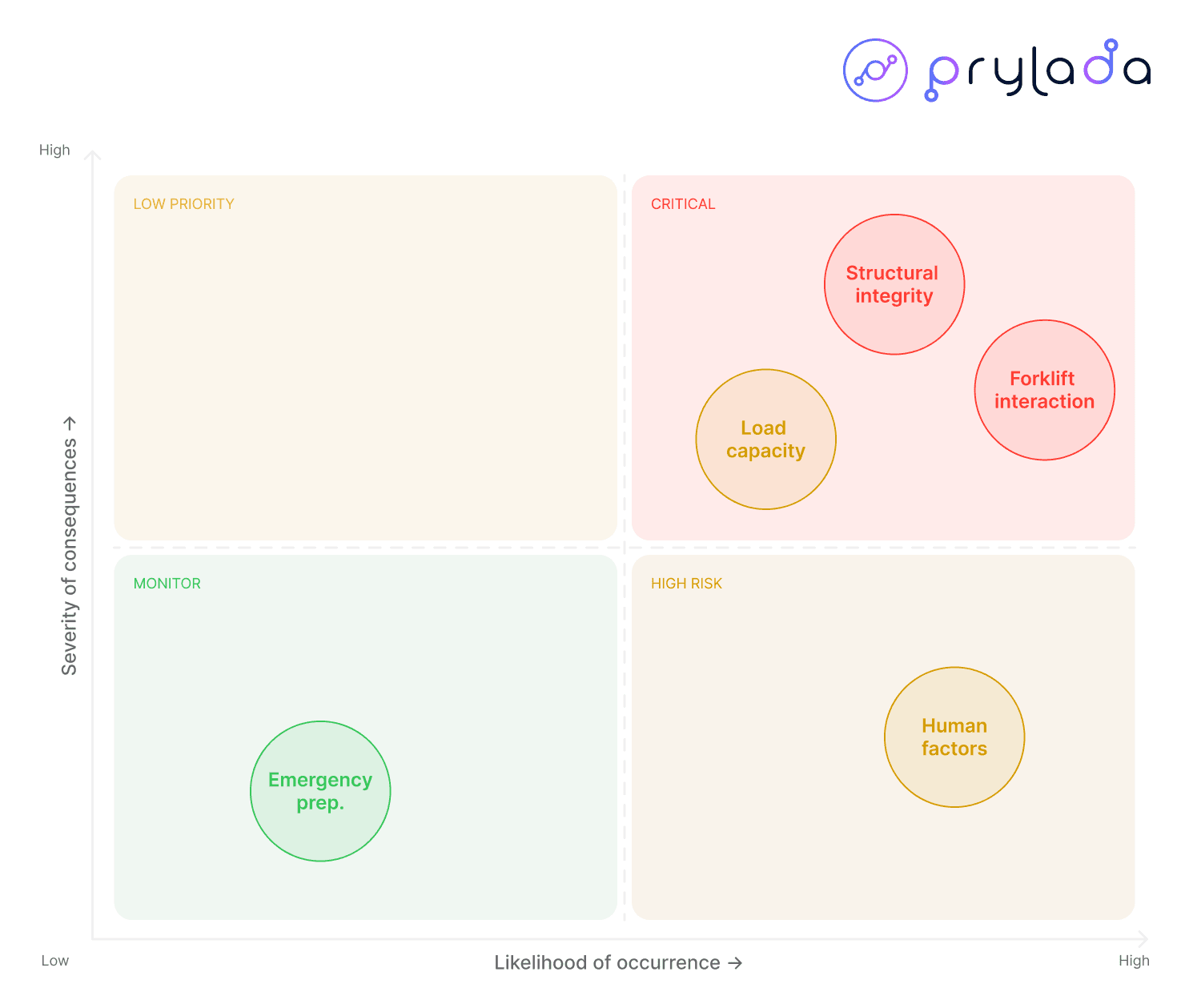
Not every hazard is equal. Once identified, each one needs to be assessed on two dimensions: how likely it is to occur, and how severe the consequences would be. The combination gives you a risk level — low, medium, high, or critical — that drives your action priorities.
This step is where a lot of organizations get stuck, especially for older installations where documentation is incomplete. If you're missing load specs or installation records, that's itself a risk factor worth flagging.
Step 3: Define Control Measures
The standard approach here is the hierarchy of controls — working from the most effective intervention down:
- Eliminate — replace the hazard entirely (retire aging racking that can no longer be reliably inspected or rated)
- Substitute — use a safer alternative (upgrade to heavier-spec beams in high-impact zones)
- Engineer — add physical safeguards (upright protectors, aisle barriers, load indicators)
- Administer — procedures, training, signage, reporting systems
- PPE — the last layer, not the primary one
Document why you've chosen each measure. If you're ever in a position where you need to demonstrate due diligence, the reasoning matters as much as the action.
Step 4: Implement and Communicate
Action plans only work when ownership is clear. Assign a responsible person for each item, set a deadline, and make sure the teams who need to know about changes actually hear about them — before the changes go live, not after.
Budget is a common sticking point. Safety improvements that get deferred due to cost almost always cost more when a failure eventually occurs.
Step 5: Monitor, Review, Repeat
Risk assessment is not a one-time document. It's a living process. Review it whenever:
- The racking configuration changes
- You introduce new types of goods with different weight or size characteristics
- A near-miss or incident occurs
- Your forklift fleet changes
- You conduct a scheduled audit
The organizations that treat this as a continuous discipline, rather than an annual report, are the ones that catch problems before they escalate.
Five Zones of Racking Risk
#1: Structural Integrity
This is the most visible risk and the one EN 15635 addresses most directly. The standard classifies damage in three tiers:
- Green — minor damage, monitor and schedule repair
- Amber — significant damage, repair as soon as possible
- Red — serious damage, unload the rack immediately and take it out of service
In practice, the green-to-amber boundary is where most organizations struggle. A slightly bent upright might not look alarming, but structural deformation compounds — especially in high-throughput environments where forklifts are moving fast, and load cycles are frequent.
Key checks: plumb and level of uprights, condition of beam-to-upright connections and safety pins, signs of corrosion (especially in cold stores or humid environments), and the condition of floor anchors and base plates.
#2: Load Capacity and Distribution
Load notices need to be present, legible, and accurate for the goods currently being stored — not the goods you were storing when the racking was installed. When goods profiles change (denser products, heavier pallets, different packing formats), load ratings need to be revisited.
Uneven weight distribution and dynamic loading during pick operations are underappreciated risks. A beam rated for a static load behaves differently when a forklift driver slams a pallet down from height.
#3: Forklift and MHE Interaction
Forklift collisions are the single largest cause of racking damage in European warehouses. When assessing this zone, look at:
- Aisle widths relative to the turning radius of vehicles actually in use
- The presence and condition of upright guards and end-of-aisle barriers
- Traffic flow logic — where do crossing paths create collision risk?
- Pedestrian segregation
One thing worth noting: many collisions go unreported. Operators don't want to flag a mistake, and supervisors don't always follow up. That means the damage picture you see is often incomplete, which is exactly why continuous monitoring is increasingly relevant here.
#4: Human Factors
Even a well-engineered system fails under time pressure, unclear procedures, or a culture where people don't feel safe reporting problems. Assessing the human side of racking risk means asking:
- Do operators have current certifications?
- Is there a clear, low-friction way to report damage or concerns?
- Does shift handover include any reference to racking condition?
- Are there productivity pressures that push people toward cutting corners?
This section is often skipped in risk assessments. It shouldn't be.
#5: Emergency Preparedness
Test the procedures, not just the documents. If a worker spots a red-category damaged upright during a busy shift, do they know what to do — and do they feel empowered to act on it? Are evacuation routes unobstructed? Are fire suppression systems appropriate for your goods type and racking height?
Inspection: Three Levels, One Continuous Picture
EN 15635 recommends a three-tier inspection program. Here's how each level works and what it's actually for.
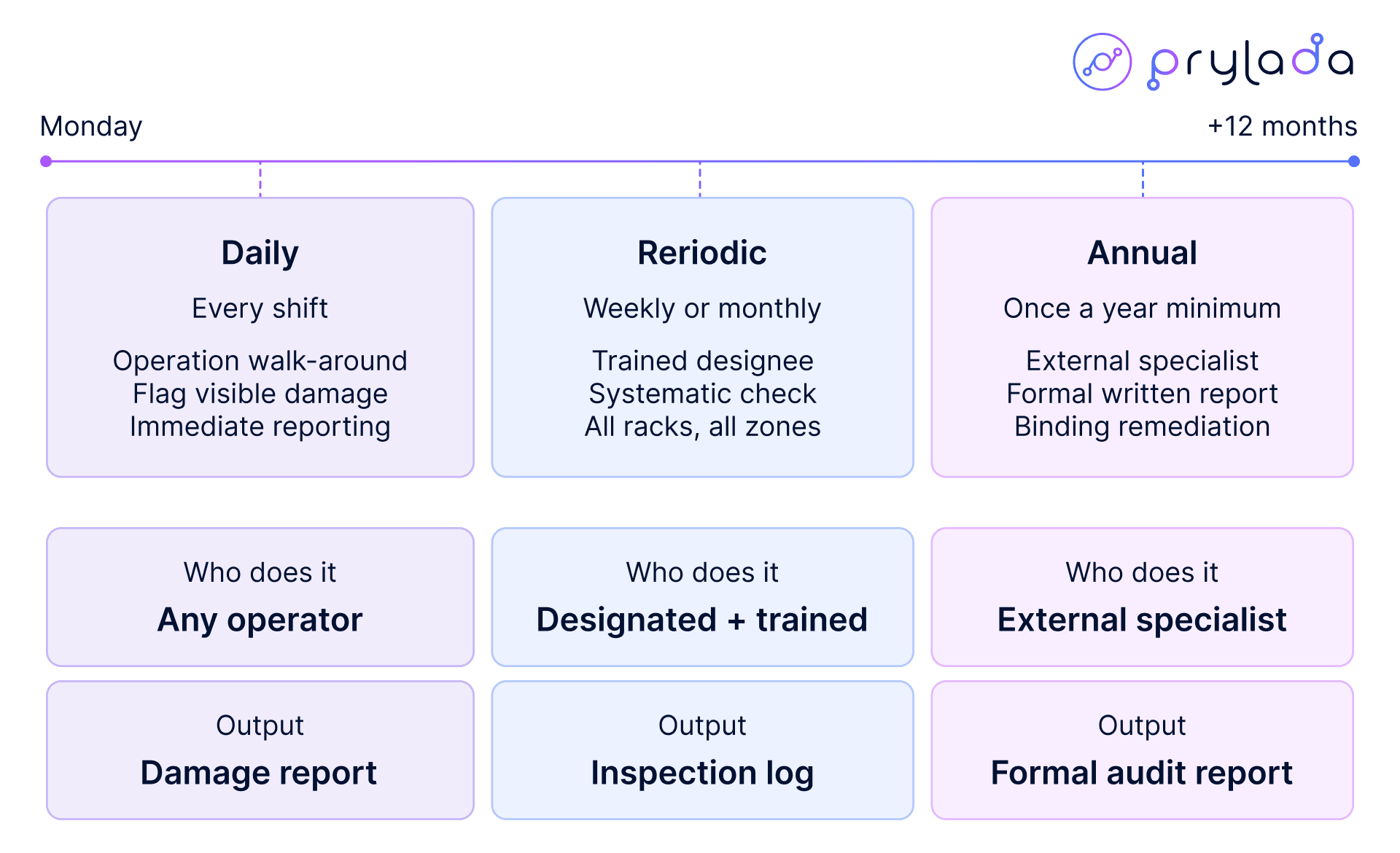
All three levels feed into the racking register — the single source of truth for structural history.
Daily inspections happen organically, as part of normal operations. Every operator who works near racking is a potential observer. The goal is to make sure damage gets flagged immediately rather than accumulating unnoticed. This requires a clear, simple reporting path — if it's complicated to report a problem, people won't.
Periodic inspections (weekly or monthly, depending on the intensity of operations) are conducted by a designated, trained person. These are systematic — every rack, every component — not just the areas that had obvious recent activity.
Expert inspections happen annually, typically conducted by an external specialist. The output is a formal written report with binding recommendations. These inspections are also the right moment to review the full assessment against changes in operations or goods profile from the previous year.
All three levels should feed a shared documentation system: a racking register that records the type, manufacturer, installation date, load ratings, any modifications, and the full inspection history.
Tools that Make Risk Assessment Practical
Inspection checklists — simple, structured, and much more reliable than memory. Adapt them to your specific racking types and warehouse layout. The best ones are short enough to complete on a mobile device during a walk-around.
FMEA (Failure Mode and Effects Analysis) — useful for more complex operations where you want to systematically map which failure modes carry the highest risk and prioritize accordingly.
Continuous monitoring technology — this is where things have moved significantly in recent years. Sensor-based systems can detect impact events, measure rack tilt and deformation, and track vibration patterns over time — providing a continuous data layer that complements periodic visual inspections. More on this below.
The racking register — often overlooked, but essential. Without a complete record of modifications, load changes, and inspection findings, you're effectively starting from zero every time you assess risk.
The Gap that Manual Inspection Can't Close
Here's the honest limitation of even a well-run inspection program: most damage happens between inspections. A forklift clips an upright at 11 pm on a Tuesday. Nobody reports it. The weekly inspection is on Friday. In between, the load on that upright doesn't decrease.
This is the problem that continuous monitoring addresses. Systems like Prylada Warehouse Safety and Collision Monitoring System use IoT sensors mounted directly on racking to detect and log impact events in real time with data on timing, location, and severity (G-force). Tilt sensors track rack inclination and deformation over time. Vibration sensors flag cumulative structural stress that wouldn't be visible in a visual inspection.
The result is a complete event log: every collision, every anomalous tilt reading, every vibration event — timestamped and geolocated. That data feeds directly into your risk assessment process, replacing guesswork with documented evidence.
Some practical applications:
- Impact detection and logging: every forklift-to-rack collision is captured, so nothing goes unrecorded between inspections
- Post-collision rack assessment: tilt data after an impact helps you decide immediately whether an inspection is needed or whether the rack can safely stay in service
- High-risk zone identification: historical data shows you where repeated impacts are clustering — so you can redesign the layout or reinforce those specific areas
- Incident investigation: when something does go wrong, you have objective data on what happened, when, and where — which matters for insurance, audits, and root cause analysis
The system scales zone by zone — one sensor per rack monitoring point, one gateway per zone, and integrates with WMS, ERP, and SCADA systems via standard APIs.
Conclusion
Risk assessment for warehouse racking isn't a one-off project or a box to tick before an audit. The organizations that do it well treat it as an ongoing operational discipline — a continuous loop of inspection, documentation, improvement, and monitoring.
The investment is real, but so is the return. Fewer incidents. Lower repair costs. Less downtime. And the harder-to-quantify value of knowing that the warehouse is genuinely safe to work in — not just compliant on paper.

The Most Comprehensive IoT Newsletter for Enterprises
Showcasing the highest-quality content, resources, news, and insights from the world of the Internet of Things. Subscribe to remain informed and up-to-date.

New Podcast Episode

Building Real-Time Voice AI Experiences

Related Articles


Related Solutions

Unit Load Device Tracking for Airports
Real-time visibility into Unit Load Devices and supporting airport assets with solar-powered tracking and BLE.
Real-time visibility into Unit Load Devices and supporting airport assets with solar-powered tracking and BLE.
SODAQ
SODAQ

Long-Endurance Aerial Monitoring and Response
AI-powered analytics and mission-ready aircraft for public safety, maritime, search and rescue, and emergency response.
AI-powered analytics and mission-ready aircraft for public safety, maritime, search and rescue, and emergency response.
Iveda
Iveda
Smart Shipping Label for Supply Chain
Easy-to-deploy shipping label that provides real-time visibility into location, condition, and handling to reduce damage and optimize logistics.
Easy-to-deploy shipping label that provides real-time visibility into location, condition, and handling to reduce damage and optimize logistics.
SODAQ
SODAQ

Related Solutions
Supply Chain & Logistics
Unit Load Device Tracking for Airports
Real-time visibility into Unit Load Devices and supporting airport assets with solar-powered tracking and BLE.
SODAQ
Maritime & Boating
Long-Endurance Aerial Monitoring and Response
AI-powered analytics and mission-ready aircraft for public safety, maritime, search and rescue, and emergency response.
Iveda
Supply Chain & Logistics
Smart Shipping Label for Supply Chain
Easy-to-deploy shipping label that provides real-time visibility into location, condition, and handling to reduce damage and optimize logistics.
SODAQ